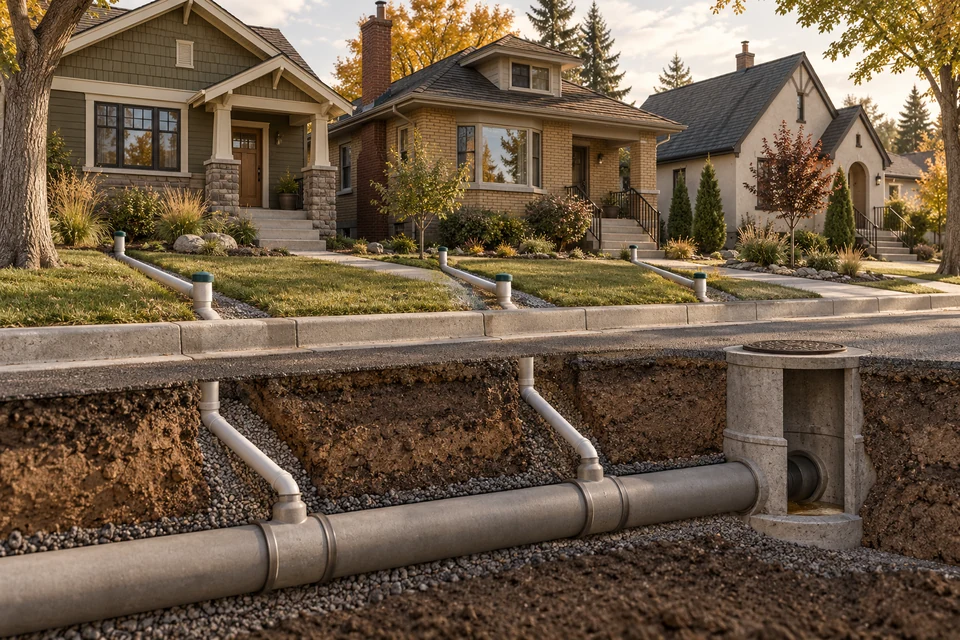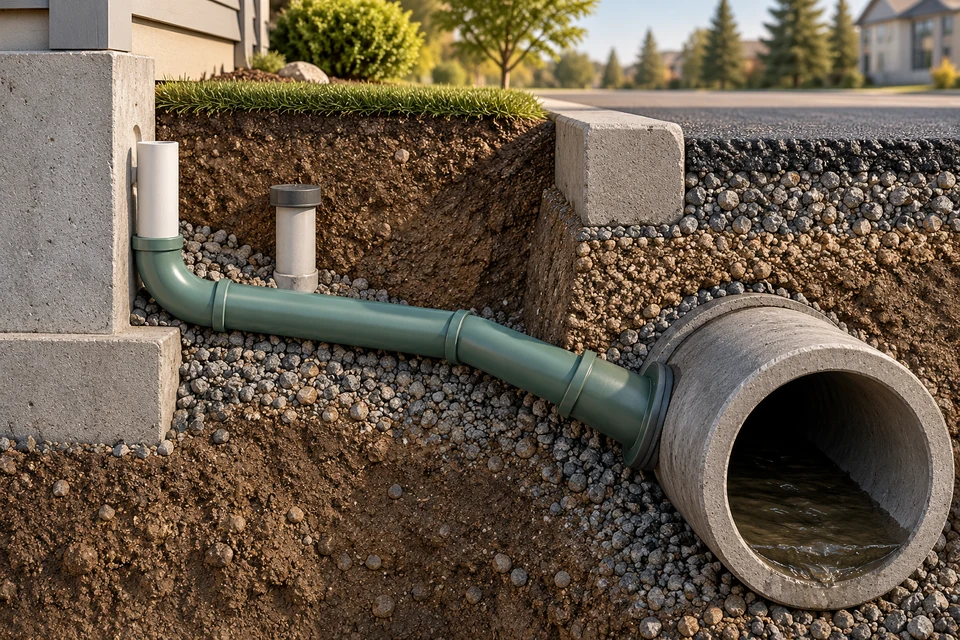
A new sewer service connection is a first-time sewer line from a new building to the municipal system, or a new tap that replaces a service that has to be abandoned. In Calgary, builders or homeowners provide the connection from the property line to the building, installed by a contractor on the City's approved indemnified list and inspected by the City. The pipe is sized for the finished building, not copied from the old one.
- A new connection is a municipal transaction as much as a plumbing job: application, the City side, road-use rules and inspection all have to line up.
- Calgary says connections from the property line are installed by contractors on its approved indemnified list and inspected against its standard specifications.
- Pipe size follows the plumbing load of what you are building, counted under the National Plumbing Code, not whatever was in the ground before.
- Suites count as separate dwelling units for backflow protection, which changes how backwater valves can be arranged.
- Keep the as-built: depth, grade, cleanouts and the connection point matter at occupancy and at every future sale.
01 /Who needs a new sewer service connection?
You need a new connection when the building on the lot is new, when the load on the service is changing enough that the old one no longer fits, or when the existing service has to be abandoned and replaced with a new tap. On a Calgary infill lot, that usually means the house that is coming down takes its old service with it.
- Infill builders replacing a demolished home and its service.
- New builds on lots without an existing municipal sewer connection.
- Secondary suites, garage suites or laneway homes that need more capacity or their own arrangement.
- Change-of-use projects that need a re-sized service.
- Small multi-family or commercial sites that need a tap sized to their occupancy.
If you are replacing a failed pipe under an existing house with no change of use, you probably need a lateral replacement rather than a new connection. Builders working across several Canadian cities will find municipal application processes compared on sister site NewSewerLines.com; this page stays with Calgary and the Alberta communities around it.
02 /What does the City of Calgary require for a new connection?
A new service connection is not only a plumbing job; it is a municipal transaction. The City of Calgary's page on water and sewer service connections, as checked in September 2026, sets out three points that shape every infill connection:
- Responsibility: builders or homeowners are responsible for providing the water and sewer service connections from the property line to the residential or commercial plumbing system.
- Who installs: the work is done by contractors on the City's approved list under its utility master indemnification agreement. Contractors seeking to qualify are directed to the City's water utility inspections contact.
- Standards and inspection: installations must meet the City's standard specifications for water services and for sewer construction, and approved plans, and the City inspects them.
The page also says it has no legal status and points readers to the bylaws and specifications themselves. Application steps, fees and the connection work on the City side are not listed there, so ask the City and your contractor for the current process before you set a schedule. Plumbing permits and inspections inside the property line follow the City's permit rules as well.
03 /How do infill projects fit the connection into the build schedule?
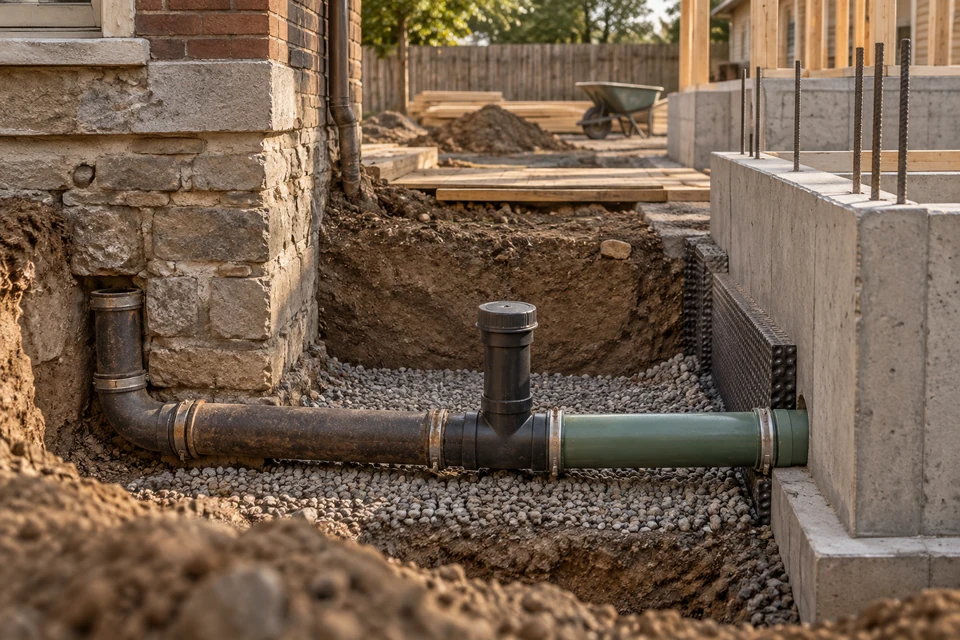
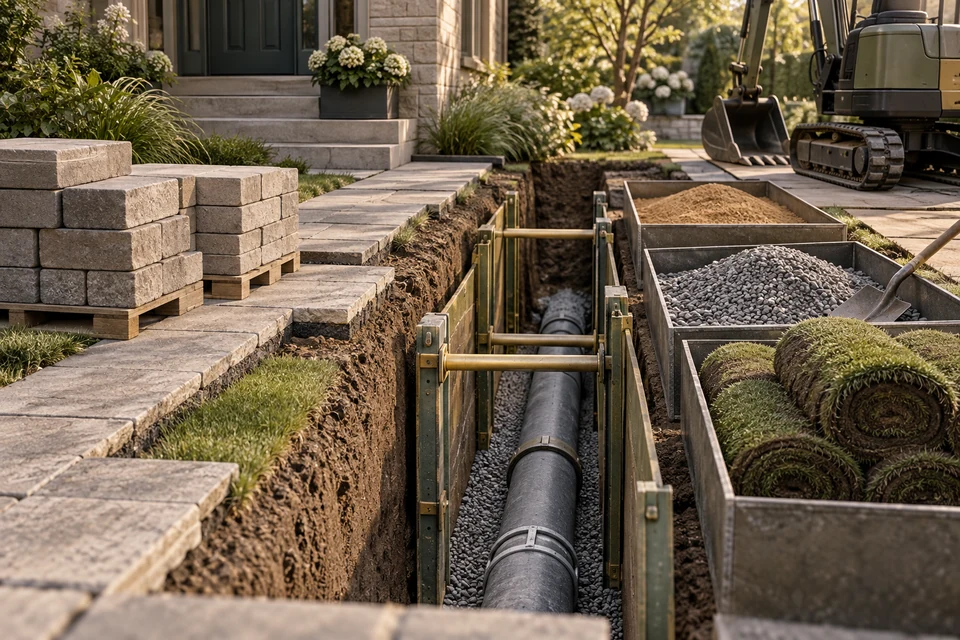
On an infill project the connection is a scheduled trade with dependencies on both sides. It usually lands after demolition and before the foundation is backfilled, because the new building sewer has to leave the foundation at the right depth and position, and the service to the property line is easiest to lay while the lot is open.
- Before demolition
Confirm with the City how the old service is to be handled, and have the existing service located and, if useful, scoped.
- Design
The plumbing designer sets the building sewer size, depth at the foundation, cleanout positions and backflow protection; the connection point and invert come from the City side.
- Permits and locates
Plumbing permit, any City permission for work beyond the property line, and a locate ticket before digging.
- Tie-in window
Coordinate the connection with the general contractor, plumbing subcontractor and site supervisor so it does not stall foundation work, framing or occupancy.
- Inspection and records
Inspection of the open work, then backfill, then an as-built with depth, grade, cleanouts and the connection point.
The broader choreography of sewer work on a construction site, including renovations that uncover a failing line mid-project, is covered in infill and renovation sewer lines.
04 /How is a new sewer service sized?
Pipe size is set by what the building will discharge, not by what was in the ground before. The National Plumbing Code of Canada, which Alberta adopted in its 2020 edition from April 1, 2023, sizes drains and sewers by hydraulic load, counted in fixture units, together with the pipe's slope. A four-bedroom house with a suite, a duplex and a small apartment building all load a service differently, and the designer works from the fixtures actually planned.
Grade matters as much as diameter. A gravity sewer needs a steady fall from the foundation to the connection; a common design slope for house sewers is about 2 percent, or roughly a quarter inch per foot, but the required minimum depends on pipe size and the code, so confirm it with your designer and inspector. On infill lots the depth of the City connection often controls everything: if the new basement is deep and the connection is shallow, there may not be enough fall for gravity, which is when pumped options enter the conversation.
| Factor | Why it matters | Who decides |
|---|---|---|
| Number and type of fixtures | Sets the hydraulic load | Plumbing designer, under the code |
| Secondary suite or garage suite | Separate dwelling unit for backflow protection | Designer and permit review |
| Basement depth vs connection depth | Decides whether gravity works | Designer, from City records |
| Change of use | Can change the load and the rules | Permit review |
| Existing service condition | Whether reuse is even possible | The City, from its requirements |
05 /Does a new build need a backwater valve?
Often, yes. A City of Calgary advisory issued on October 4, 2022 reminds builders, designers and installers that the National Plumbing Code 2020 requires fixtures below the level of the adjoining street and subject to backflow to be protected, citing Article 2.4.6.4. It adds that a normally open backwater valve may be used on a building drain or branch only if it does not serve more than one dwelling unit, and that a secondary suite counts as a separate dwelling unit.
For an infill house with a legal basement suite, that means backflow protection has to be designed for each unit rather than as one valve on the main drain. The advisory notes that existing installations where one normally open valve serves more than one unit may need to be removed, reconfigured or supplemented. As a planning estimate, a backwater valve in new construction commonly adds $800 to $2,500 CAD; retrofits in finished basements cost more.
06 /What records should I keep from a new connection?
Ask for a documentation package and keep it with the house: the written scope, the permits, the inspection sign-off and an as-built showing depth, grade, cleanout locations and the connection point. That package matters when the building is inspected for occupancy, when a future owner asks what is under the lawn, and when anyone ever needs to find, clean or camera the line.
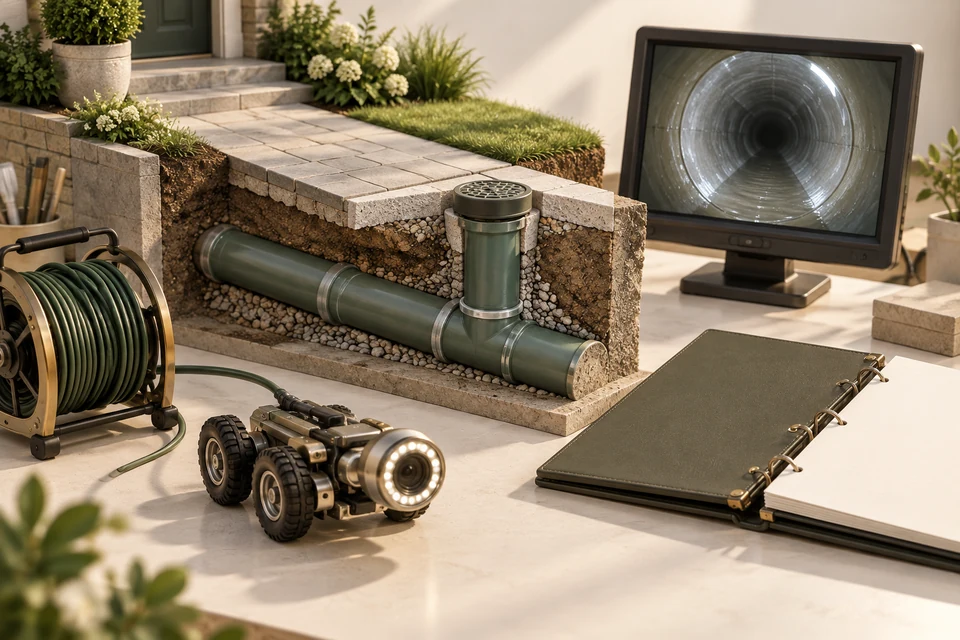
An after-video from the cleanout to the connection is the simplest proof that the new service is continuous, on grade and clean of construction debris. Handover and warranty lists what a good closing package contains. To plan costs and steps, use the project planner with the project set to a new service, then send the plans for quotes.
FAQQuestions people ask
Who is responsible for a new sewer connection in Calgary?
The City's connections page says builders or homeowners provide the water and sewer service connections from the property line to the building, installed by approved indemnified contractors and inspected by the City.
Can an infill house reuse the old sewer service?
Sometimes, but it depends on the City's requirements, the old service's condition and whether its size and depth suit the new building. Ask the City before demolition and scope the old service if reuse is being considered.
What size sewer line does a new house need?
The size comes from the plumbing load of the fixtures planned, counted under the National Plumbing Code, plus the slope available. The designer calculates it for the permit.
Does a secondary suite need its own backwater valve?
A City of Calgary advisory says a normally open backwater valve may not serve more than one dwelling unit, and a secondary suite is a separate unit, so protection has to be arranged for each.
When should the sewer connection happen on an infill build?
Usually after demolition and before the foundation is backfilled, in a window agreed with the general contractor and plumbing subcontractor so it does not hold up foundation work or occupancy.
NETWORKGo deeper across the HAUSE Sewer network
Sewer permits, inspections and who pays: owner or city?
Sewer line permits and who pays in Canada: the usual owner vs city split, permit and inspection costs, road cuts, city tree roots and what to confirm.
Sewer inspection points and cleanouts: how to find, use or move one
What a sewer inspection point, chamber or cleanout is, how to find yours in a Canadian house, whether you can move or add one, and scoping through a toilet.
Condo and apartment drain stack cleaning
Condo and apartment drain stack cleaning: why kitchen stacks back up on lower floors, how stacks are jetted or descaled, and how boards schedule it.