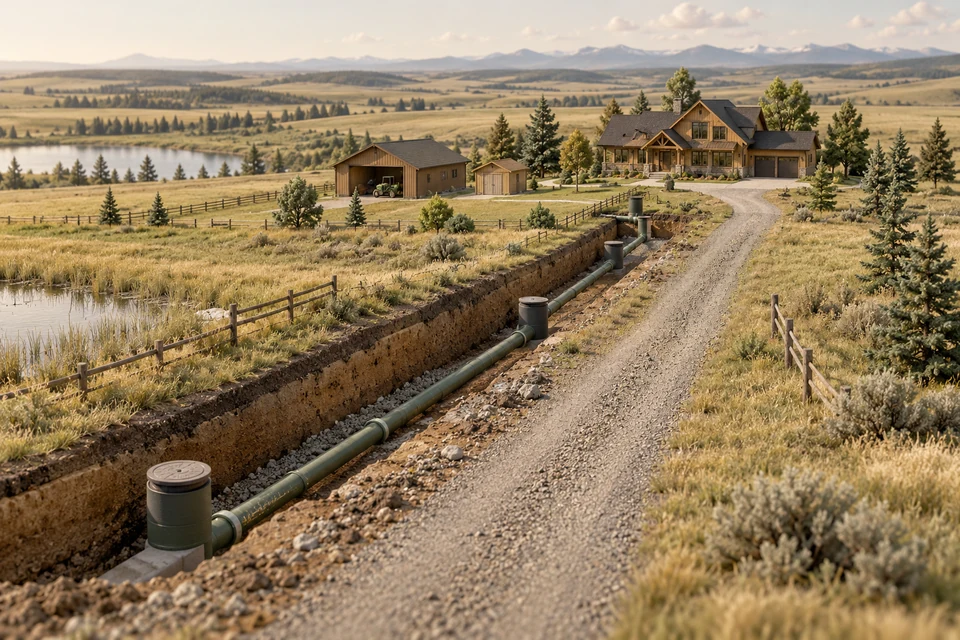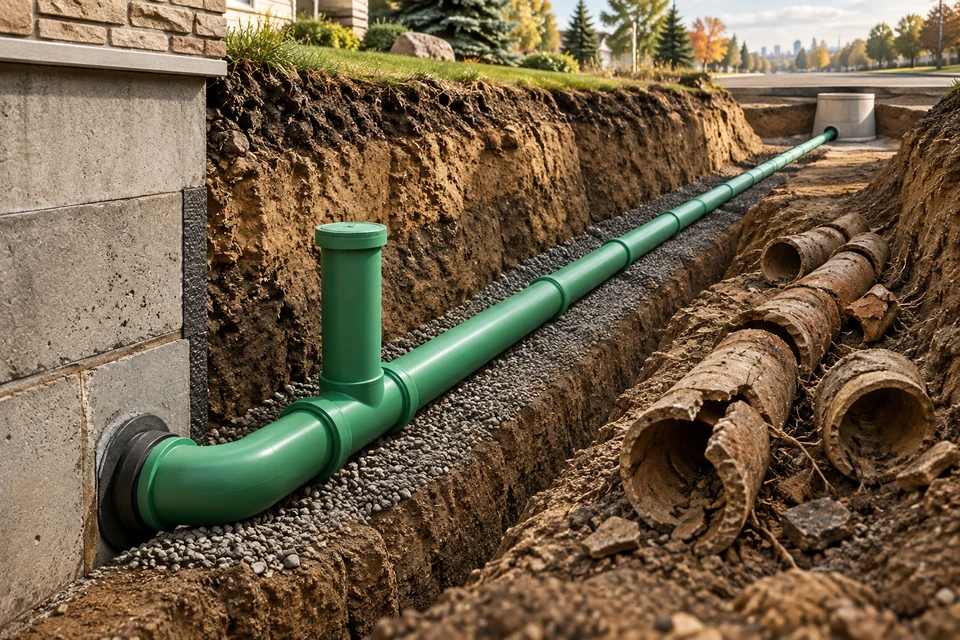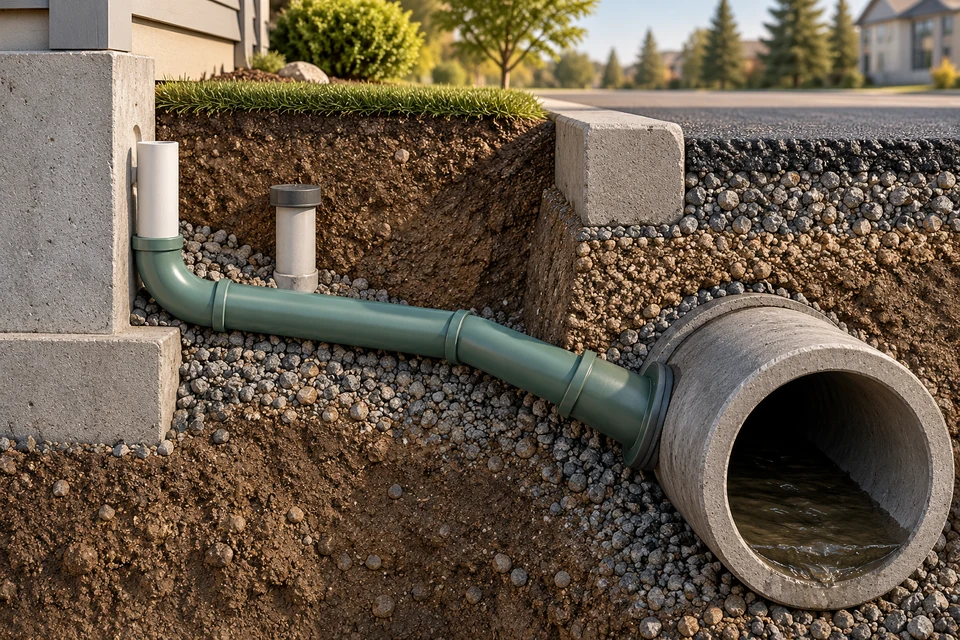
Calgary homeowners own the sewer pipe from the property line to the house; the City owns the section from the property line to the main. New lines are most common in communities built before about 1960, where City records show many service lines of that age, and on infill lots being rebuilt. Replacing the private line needs a City plumbing permit, and road work needs an excavation permit.
- The City publishes the ownership split with its sanitary service line data: its section runs from the main to the property line.
- In Inglewood, Ramsay, Renfrew, Rosedale, Bankview and Sunnyside, half or more of the City-side service lines on record are dated before 1960.
- High PVC shares and recent median years in Altadore, Killarney and Parkdale are consistent with infill redevelopment replacing services.
- City records cover only the City's section; your private pipe can be a different material and age.
- Plumbing permits, right-of-way excavation permits, the approved-contractor rule for new connections and the backflow advisory all come from the City.
01 /Which Calgary communities need new sewer lines most often?
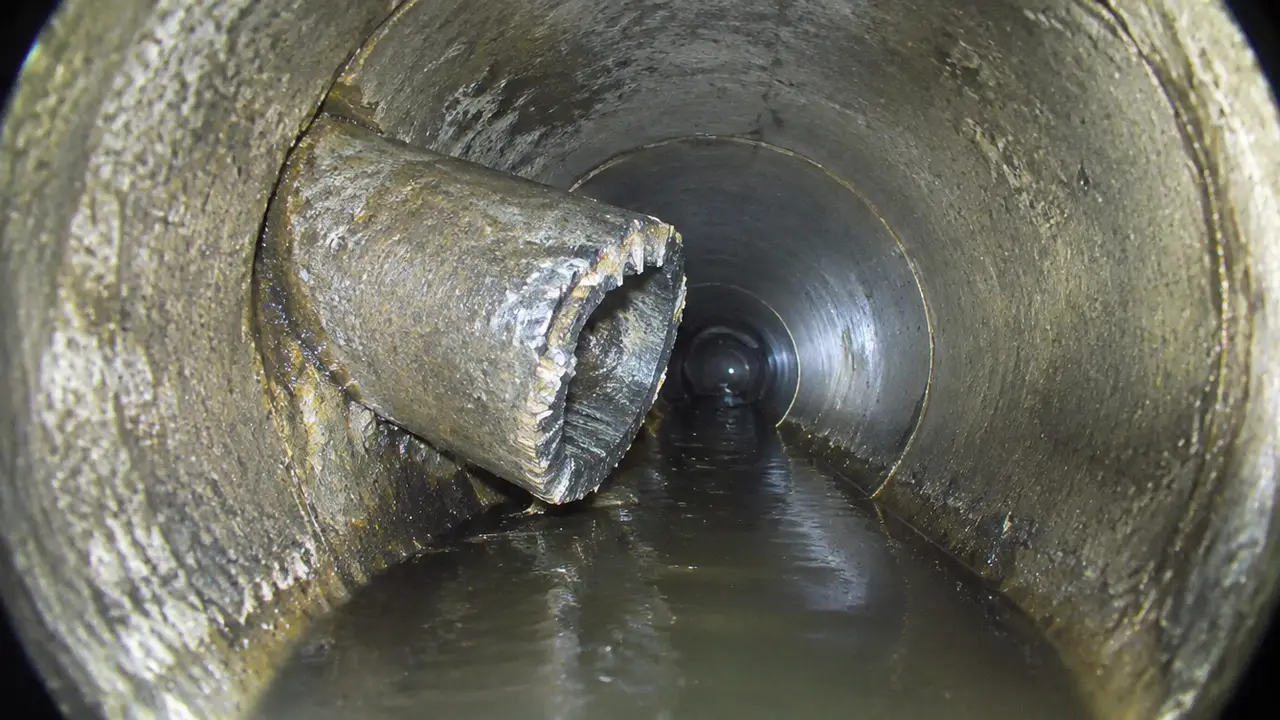
Established Calgary communities are on their second or third generation of owners, and many still run on the sewer pipe installed with the original house. Replacement demand concentrates in the older inner-city communities, where laterals of clay or cast iron are now 60 to 80 years old or more. Newer houses appear too, usually as insurance or real estate condition jobs after a routine scope finds a break.
Communities that come up again and again include Killarney, Bowness, Bridgeland, Inglewood, Renfrew, Rosedale, Mount Pleasant, Sunnyside, Hillhurst, West Hillhurst, Altadore and the Marda Loop area, Bankview, Mission, Ramsay, Crescent Heights, Tuxedo Park, Highland Park, Capitol Hill and Parkdale. HAUSE takes requests from every quadrant of the city; it is an information and request network, not a crew, so the desk passes requests on rather than scheduling work itself.
02 /What do the City's service line records show for those communities?
The City of Calgary publishes a record for the City-owned section of each sanitary service line: material code, diameter, length and installed date. The HAUSE network's Calgary atlas groups those records by community. The table below uses that atlas for the communities listed above. It describes the City's section only.
| Community | Lines | Median year | Before 1960 | Cast iron | PVC | Relined | OTHER code |
|---|---|---|---|---|---|---|---|
| Killarney/Glengarry | 2,348 | 1996 | 33.7% | 15.4% | 51.1% | 3% | 27.6% |
| Bowness | 3,571 | 1968 | 7.3% | 41.6% | 17.9% | 0.1% | 3.5% |
| Bridgeland/Riverside | 1,102 | 1960 | 49.5% | 12.3% | 31.7% | 2.1% | 50.1% |
| Inglewood | 1,037 | 1954 | 57.4% | 9.2% | 30.3% | 0.3% | 58.1% |
| Renfrew | 1,870 | 1955 | 56.2% | 13.6% | 32.5% | 1.5% | 45.5% |
| Rosedale | 592 | 1950 | 56.1% | 2.2% | 30.1% | 9.3% | 57.1% |
| Mount Pleasant | 2,273 | 2004 | 33% | 8.7% | 45.6% | 11.2% | 32.6% |
| Sunnyside | 658 | 1959 | 50.2% | 12.8% | 26.1% | 4.3% | 53.2% |
| Hillhurst | 1,451 | 1990 | 33.4% | 9.7% | 48.1% | 3.9% | 33.6% |
| West Hillhurst | 2,294 | 1998 | 28.7% | 14.2% | 54.7% | 4.3% | 24.6% |
| Altadore | 2,239 | 2007 | 25.3% | 11.1% | 68.7% | 0.4% | 12.3% |
| South Calgary (Marda Loop area) | 1,071 | 1989 | 33% | 14.8% | 50.3% | 0% | 29.5% |
| Bankview | 768 | 1957 | 54.2% | 17.3% | 24.3% | 3.8% | 47.4% |
| Mission | 186 | 1959 | 50.5% | 30.1% | 12.9% | 0% | 48.9% |
| Ramsay | 882 | 1954 | 60.4% | 12.2% | 27% | 1.7% | 57.5% |
| Crescent Heights | 1,395 | 1965 | 46.5% | 9% | 24.4% | 16% | 47.6% |
| Tuxedo Park | 1,729 | 1978 | 36.4% | 16.5% | 40.9% | 1.7% | 36.6% |
| Highland Park | 1,321 | 1958 | 52.5% | 27.5% | 31.9% | 1.6% | 28.9% |
| Capitol Hill | 1,542 | 1973 | 37.5% | 15.9% | 41.2% | 2.2% | 35.6% |
| Parkdale | 766 | 2005 | 35.5% | 9% | 58.2% | 0% | 31.5% |
Three readings stand out. First, in Inglewood, Ramsay, Renfrew, Rosedale, Bankview, Sunnyside, Highland Park and Mission, half or more of the City-side lines on record are dated before 1960. Second, Bowness and Mission have unusually high cast iron shares on the City side, at about 42 and 30 percent. Third, Altadore, Parkdale, Mount Pleasant and Killarney combine a large PVC share with a median install year in the 1990s or 2000s. That pattern is consistent with redevelopment, since infill rebuilds usually get new services, although the data does not say why each line was replaced.
03 /How can I check the record for my own street?
The City publishes its sanitary service line records as open data, with a map. Find your address, and the record for the City section of your connection shows its material code, diameter, length and installed date. If the record looks wrong, the City asks you to contact 311. Remember what the record cannot tell you: the condition of that pipe, or anything about the section on your side of the property line. For that, the only answer is a camera run from your cleanout, and the footage is what a contractor quotes from.
04 /Who owns which part of a Calgary sewer line?
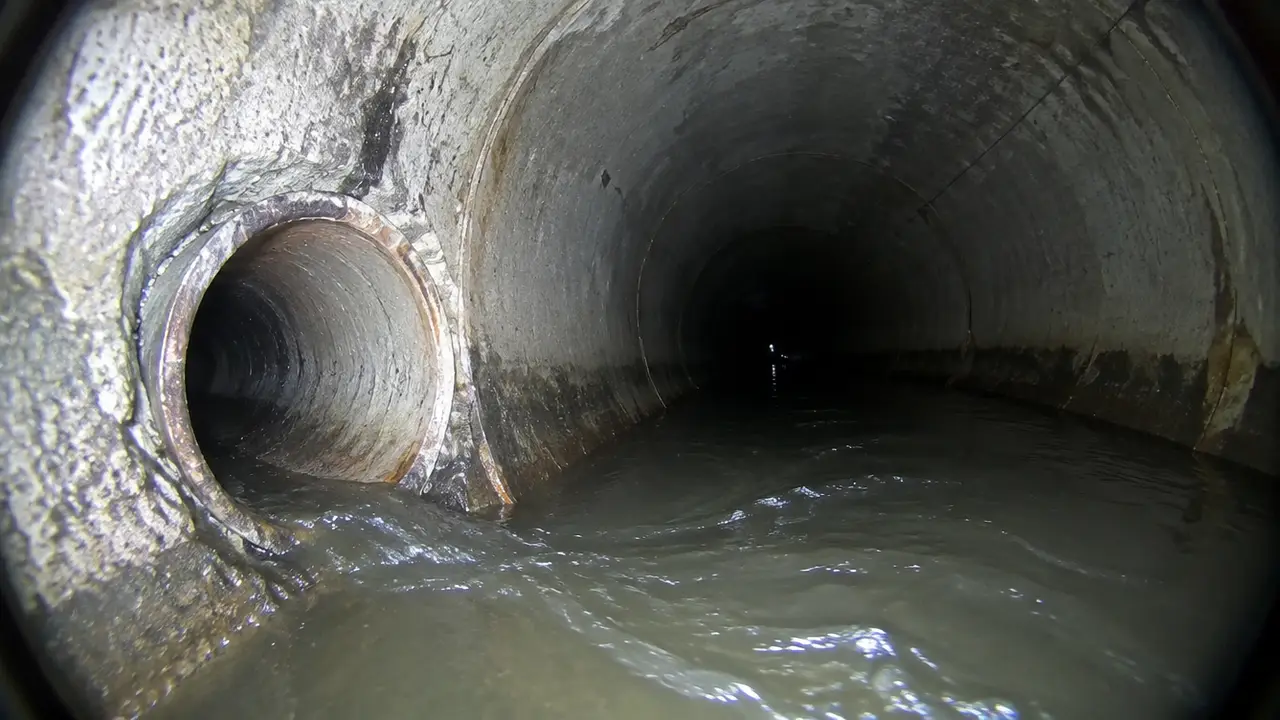
The City describes a sanitary service line as two sections. From the sanitary main to the property line, the pipe is owned and maintained by the City of Calgary. From the property line to the house, it is owned and maintained by the homeowner. That text is published with the City's open data on public sanitary service lines, which also asks anyone who believes a recorded material is wrong to contact 311.
For a new connection on an infill lot, the City's connections page puts it the same way: builders or homeowners provide the water and sewer connections from the property line to the building's plumbing, and the City inspects them. If a camera finds a problem on the City side, call 311 before booking any work there.
05 /Which City rules apply to a new sewer line in Calgary?
Four City rules shape almost every Calgary new-line project. Each was checked on the City's own pages in September 2026; confirm them before you commit to dates, because they can change.
| Rule | What the City says | Applies to |
|---|---|---|
| Plumbing permit | Replacing water and sewer lines in or around the home needs a plumbing permit; homeowner permits only for owner-occupants doing the work themselves ($112 plus a 4% Safety Codes Council fee) | Every private-side replacement |
| Excavation permit | Needed to break or dig into a City road right-of-way; apply up to two weeks ahead; standard processing up to two business days; backfill maintained for two years | Work beyond the property line |
| New connections | Connections from the property line installed by contractors on the City's approved indemnified list, to its standard specifications, and inspected by the City | Infill and new builds |
| Backflow protection | A normally open backwater valve may not serve more than one dwelling unit; a secondary suite is a separate unit (advisory, October 2022) | Houses with suites |
The City also runs a sanitary lateral lining program that installs liners inside existing sanitary service pipes without digging. Its page describes the preparation residents are asked to do and a connection outage of about three hours. It does not describe work on the private section, so a City liner on your street is not a new line on your lot.
06 /What about the communities around Calgary?
Beyond city limits, requests come from Airdrie, Cochrane, Chestermere, Okotoks, Strathmore, Bragg Creek, De Winton, Balzac, Langdon, Rocky View County and Foothills County. Each town and county sets its own ownership boundary, permits and connection rules, and acreage lines are often a different kind of job altogether. The Alberta service area page covers what to ask outside the city.
Whether you are in Calgary or around it, the order of work is the same: scope, locates, a route plan, a written quote, permits, the dig, inspection, backfill and records, as the process page sets out. Start with the New Line or Repair? Check if you are not yet sure a new line is needed, and use the project planner with the location set to Calgary for the City rules at each step. When you want contractors to look at it, send your community, footage and details.
FAQQuestions people ask
Does the City of Calgary replace the sewer line on my property?
No. The City owns and maintains the section from the main to the property line. The section from the property line to the house belongs to the homeowner, who arranges and pays for its replacement.
What is my Calgary sewer service line made of, and how do I check?
The City's open data shows the recorded material of its own section. Your private section can differ, so a camera inspection from your cleanout is the only reliable answer.
Do I need a permit to replace my sewer lateral in Calgary?
Yes. The City lists replacing water and sewer lines in or around the home as work that needs a plumbing permit, and any digging in a City road right-of-way needs an excavation permit.
Which Calgary neighbourhoods have the oldest sewer service lines?
On the City side, communities such as Inglewood, Ramsay, Renfrew, Rosedale, Bankview and Sunnyside have half or more of their recorded service lines dated before 1960.
Who do I call about a sewer problem at the property line in Calgary?
Call 311. The City assesses problems on its section, and knowing which side a defect is on changes who arranges and pays for the repair.
NETWORKGo deeper across the HAUSE Sewer network
Sewer permits, inspections and who pays: owner or city?
Sewer line permits and who pays in Canada: the usual owner vs city split, permit and inspection costs, road cuts, city tree roots and what to confirm.
Lateral defect map: plot your sewer inspection findings
Turn a sewer camera report into a strip map: enter footage-counter distances, defect types and depths to see where each finding sits and how urgent it is.
Hydro jetting weeping tile: how foundation drains are cleaned, and when they cannot be
Hydro jetting weeping tile explained: how foundation drains clog with silt, roots and iron ochre, how they are jetted from the sump, and when to replace them.