This glossary defines the words you meet when getting a new sewer line in Calgary or Alberta: the parts of the line, the camera findings, the methods, the permit and locate terms, and the words that appear in quotes and warranties. Each definition is written for a homeowner reading a quote, not for an engineer, and points to the page where the idea is explained in full.
- Lateral, building sewer and service line are used loosely; in Calgary the City's section ends at the property line.
- Quote terms such as owner scope, as-built and restoration decide what you are actually buying.
- Locate terms matter because your own sewer line is never marked by the one-call.
01 /How should I use this glossary?
Keep it open next to a quote or a camera report. When a term is unclear, look it up here, then read the linked page for the full picture: sewer lateral replacement for the parts of a job, excavation and restoration for the dig, the process page for the order of work, and the cost page for the line items.
Where a term has a specific legal or code meaning, such as a permit type or a section of Alberta's OHS Code, the definition says so and the full rule is on the linked page with its source. Rules were checked in September 2026 and can change.
A–ZTerms
- Abandoned pipe
- Old pipe left in the ground instead of removed, usually under a structure. It should be capped as required and marked on the as-built.
- ABS
- Acrylonitrile butadiene styrene, a black plastic drain pipe common inside Canadian houses. It often meets the new sewer line at the foundation.
- Accredited agency
- An organisation that issues permits and inspects on behalf of the province in Alberta municipalities that are not accredited under the Safety Codes Act.
- Accredited municipality
- An Alberta municipality accredited to administer the Safety Codes Act, which issues its own permits and inspections.
- After-video
- A recorded camera run through the new line at handover, showing it continuous, clean and on grade. The baseline for any warranty claim.
- A division of the Safety Codes Council that oversees permitting and inspection through accredited agencies where a municipality is not accredited.
- As-built
- A drawing or sketch of what was actually installed: route, depth, cleanout locations and the connection point.
- Backfill
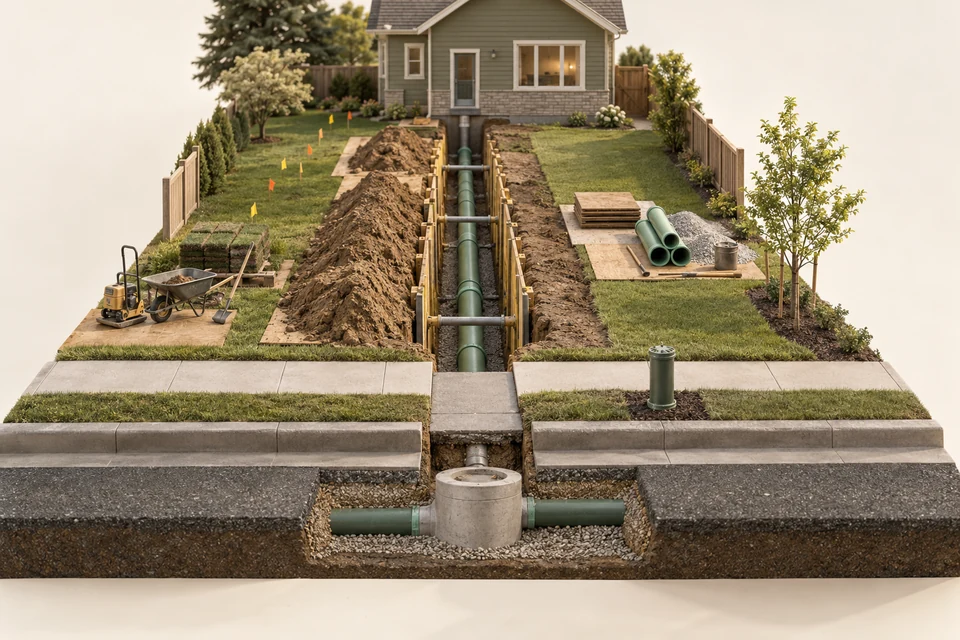
- The material put back into a trench after the pipe is laid and inspected, ideally placed and compacted in lifts.
- Backwater valve
- A valve on a drain that lets water flow out and closes against backflow from the sewer. In Calgary a normally open valve may not serve more than one dwelling unit.
- Bedding
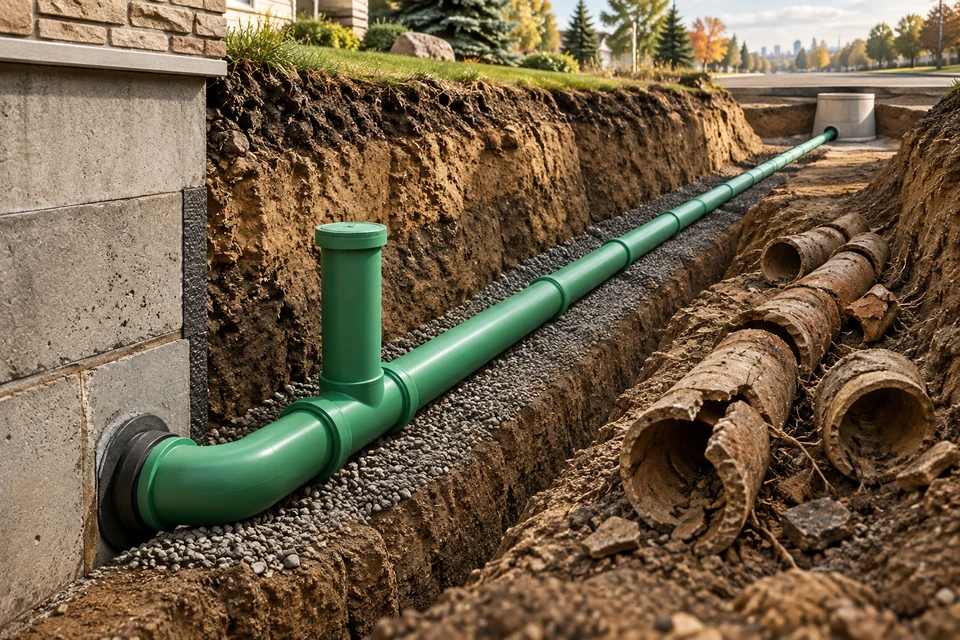
- The layer of material under and around the pipe that supports it evenly and keeps it on grade.
- Belly (sag)
- A low section of pipe below the designed grade where water and solids collect. A liner cannot fix it; that section is re-laid.
- Benching
- Cutting trench walls into steps to reduce the height of vertical faces. One way of protecting a deep trench.
- Bituminous fibre (Orangeburg)
- A tar-impregnated fibre pipe used in some mid-century houses. It deforms and delaminates and is replaced rather than repaired.
- Building drain
- The lowest horizontal drain inside a building, collecting the stack and fixtures and carrying them out through the foundation.
- Building sewer
- The pipe that continues from the building drain outside the building to the public sewer or a private sewage system. Homeowners usually call it the lateral.
- Camera scope
- A recorded inspection of the inside of a sewer line with a push camera, usually with a distance counter and a sonde for locating.
- Cast iron
- A heavy metal drain pipe common in older houses. It corrodes from the inside over decades, which can leave a thin bottom wall.
- City side
- In Calgary, the section of the sanitary service line from the main to the property line, owned and maintained by the City.
- Cleanout
- A capped access fitting on a drain that lets cameras and cleaning tools into the line without pulling a toilet.
- Collapse
- A section of pipe that has lost its shape or bore. It must be dug out or burst through; a liner cannot form across it.
- Compacted lifts
- Backfill placed in layers, each compacted before the next, so the trench does not settle later.
- Compulsory certification trade
- An Alberta trade that must be practised by certified journeypersons or registered apprentices. Plumber is one.
- Cured-in-place pipe (CIPP)
- A resin-saturated liner inserted into an old pipe and cured to form a new pipe inside it, without digging a trench.
- Customer-owned line
- A buried line owned by the property owner, such as the sewer and water service, sprinklers and power to outbuildings. The one-call does not mark these.
- Dwelling unit
- A self-contained home. A secondary suite counts as a separate dwelling unit for backflow protection in Calgary.
- Excavation permit
- A City of Calgary permit to break or dig into a City road right-of-way. Its holder maintains the trench backfill for two years.
- Fixture unit
- The measure of hydraulic load the plumbing code uses to size drains and sewers from the fixtures they serve.
- Frost
- Ground frozen in winter. Frost has to be broken or thawed for winter digs, and final restoration often waits for spring.
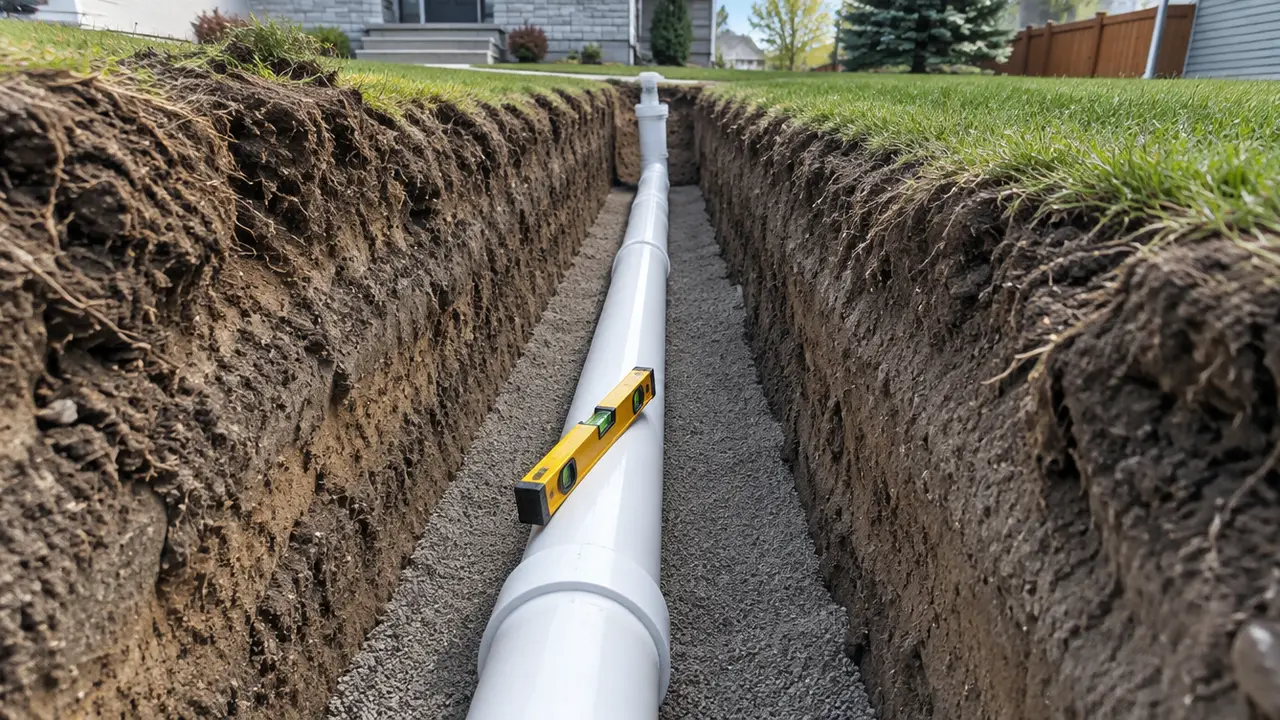
- Grade (slope)
- The steady fall of a gravity sewer toward the main. The required minimum depends on pipe size and the code.
- Hand-expose zone
- The area around a marked utility, one metre either side of the marks for most lines, where it is exposed with hand tools before machines dig.
- HDPE
- High-density polyethylene, a flexible plastic pipe that is butt-fused into one length and pulled in behind a bursting head.
- Homeowner permit
- In Calgary, a plumbing permit for an owner who lives in the home and does the work personally. It comes with rough-in and final inspections.
- Hydrogen sulphide (H2S)
- A toxic gas that can collect in sewers, tanks and trenches. It smells of rotten eggs at low levels but deadens the sense of smell at higher ones.
- Infill
- A new house built on a lot in an established neighbourhood, usually after the old house is demolished. It normally needs a new sewer service.
- Inspection (open trench)
- The permit inspection of the new pipe, bedding and connections before backfill. Nothing should be covered before it.
- Invert
- The inside bottom of a pipe. Invert depths at each end decide the fall available for a gravity line.
- Lateral
- The private sewer pipe from the house to the municipal connection. Used loosely for the building sewer.
- Line-item quote
- A quote that lists pipe, method, length, permits, cleanout, restoration and exclusions separately, so it can be compared.
- Locate
- Marking the position of buried utilities on the ground before digging. In Alberta, requested through Utility Safety Partners.
- Master indemnification agreement
- The City of Calgary agreement under which approved contractors install water and sewer service connections from the property line.
- Municipal main
- The public sewer pipe under the street or lane that laterals connect to.
- National Plumbing Code of Canada (NPC)
- The model plumbing code Alberta adopts. The 2020 edition has been in force in Alberta since April 1, 2023.
- Offset joint
- A joint where pipe ends no longer line up, leaving a lip that catches paper and roots.
- Open cut
- Replacing a sewer line by digging a trench along its length. It can fix grade problems that trenchless methods cannot.
- Owner scope
- Work the homeowner agrees to do, such as clearing plants or laying sod, written into the quote so nobody assumes otherwise.
- Pipe bursting
- A trenchless method that pulls a cone-shaped head through the old pipe, breaking it outward, while new HDPE follows behind.
- Plumbing permit
- The permit required for plumbing work, including replacing water and sewer lines in or around a home in Calgary.
- Private locator
- A company hired to find and mark customer-owned lines that the one-call service does not mark.
- Private sewage system
- A tank and treatment system on the property instead of a municipal sewer, common on acreages. Regulated under Alberta's private sewage discipline.
- Property line
- The legal boundary of the lot. In Calgary, where the City's section of the sewer service ends and the homeowner's begins.
- PVC
- Polyvinyl chloride, the plastic pipe used for most new sewer laterals laid in a trench. City records show it dominant on City-side lines since the 1980s.
- Restoration
- Putting back everything the dig disturbed: soil, sod, concrete, landscaping, irrigation. Each surface should be its own line item.
- Restricted Certificate of Competency "R"
- An Alberta certificate that contractors may require for sewer and water services.
- Right-of-way
- Public land along a street, including the road, boulevard and sidewalk. Digging in it needs municipal permission.
- Rough-in inspection
- In Calgary, the inspection once drainage and venting are installed and before they are covered.
- Sanitary lateral lining program
- A City of Calgary program that installs liners inside existing sanitary service pipes without digging.
- Sectional liner
- A short liner that repairs one defect from inside the pipe, also called a point repair.
- Service connection
- The link from a building to the municipal sewer. A new one is needed for most infill and new builds.
- Sonde
- A small transmitter in a camera head that lets a technician find the camera's position and depth from the surface.
- Spoil
- The soil dug out of a trench. In Alberta, spoil piles stay at least one metre back from the trench edge.
- Stack
- The vertical drain pipe that carries waste down through the house to the building drain, venting through the roof.
- Tie-in
- The connection of the new line to the existing house stub or the municipal connection.
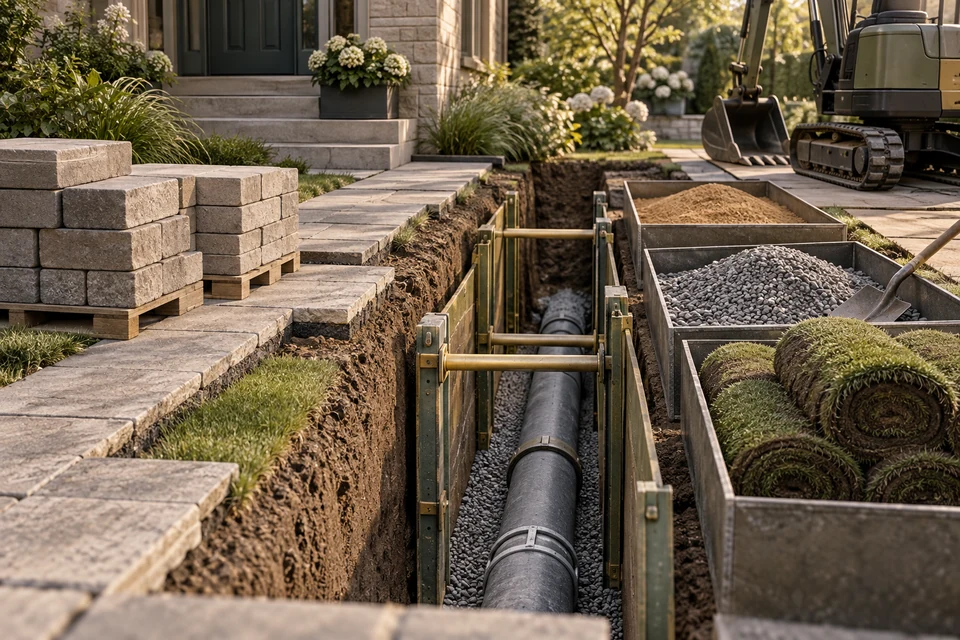
- Trench box
- A steel or aluminium protective structure placed in a trench to hold back the walls while people work inside.
- Utility Safety Partners
- Alberta's one-call locate service. It asks for at least three full working days of notice for a routine request.
- Vitrified clay
- Fired clay pipe used for older sewer laterals. Its joints are prone to root intrusion and offsets as the ground moves.
FAQQuestions people ask
Where does the building drain end and the building sewer begin?
The building drain is the lowest drain inside the house; the building sewer continues from it outside to the municipal sewer or a private system. The code draws the exact boundary.
What does owner scope mean on a sewer quote?
Work the homeowner has agreed to do, such as removing plants or laying sod. It should be written into the quote so both sides know who does what.
What is an as-built drawing for a sewer line?
A sketch of what was actually installed: the route, depth, cleanout locations and connection point. Keep it with the house records.