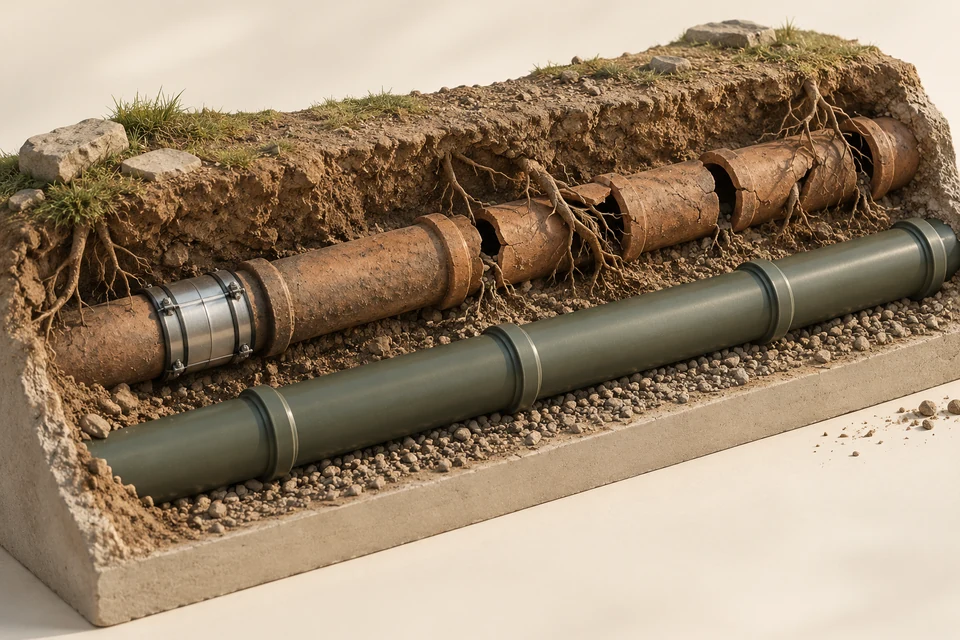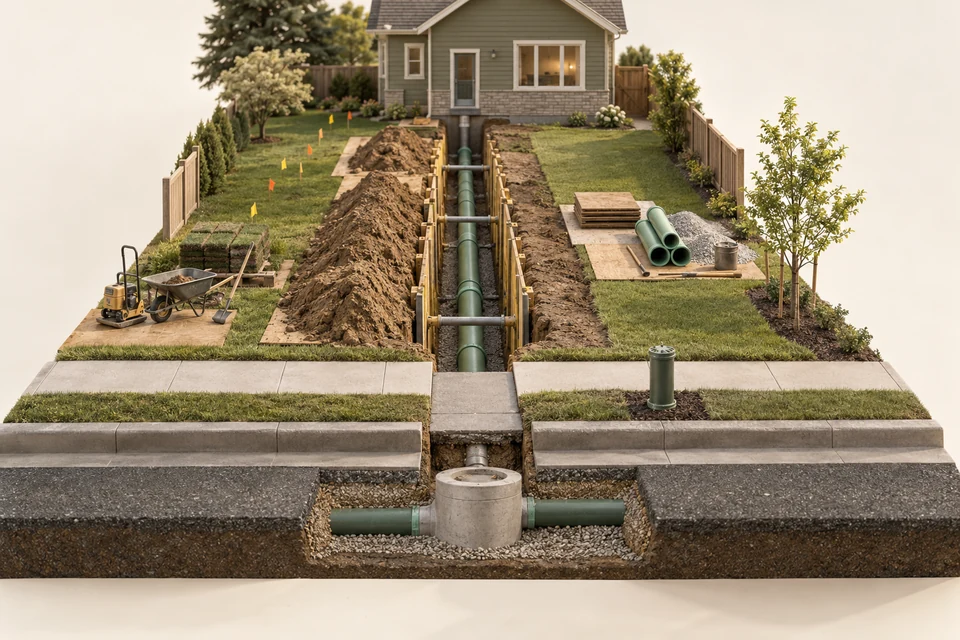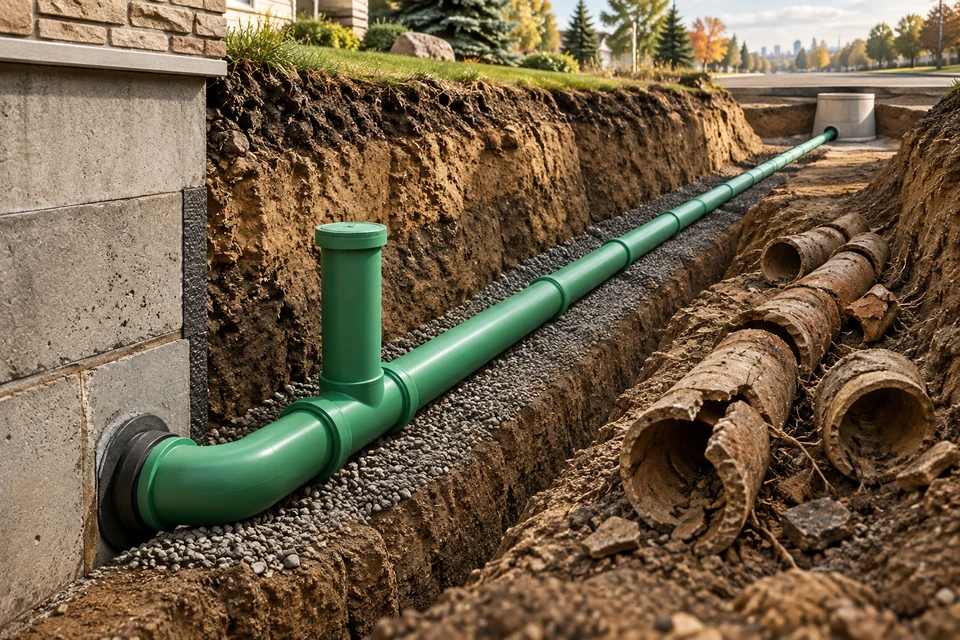
A sewer lateral replacement removes the failed private sewer pipe and installs a new, correctly graded line, usually PVC, from the house stub to the municipal connection, under a permit and an inspection. In Calgary the homeowner owns the lateral from the house to the property line. Most single-family replacements take one to three working days on site once permits and locates are in hand.
- Replacement is the honest recommendation when the camera shows failures at several points, a belly, collapse, or clay, cast iron or Orangeburg that has aged out.
- A complete job includes the scope, locates, permits, a protected trench, bedding and grade, an open-trench inspection, compacted backfill and records.
- Refuse fixed prices given without a camera scope, and ask for any pipe left in the ground to be capped and recorded in writing.
- The City of Calgary's own lateral lining program works inside existing service pipes; it is not a replacement of your side.
- Plan the job with the project planner and compare quotes line by line, not by total.
01 /What is a sewer lateral replacement?
The sewer lateral is the pipe that carries everything from your house to the municipal sewer main. A replacement takes out the old pipe, or abandons it where it cannot be removed, and lays a new one on proper bedding at a steady grade, connected at the house stub at one end and at the municipal connection at the other. It is different from a repair, which fixes one spot, and from lining, which builds a new pipe inside the old one.
In Calgary the split of responsibility is published. The City describes each sanitary service line as two sections: from the main to the property line, owned and maintained by the City, and from the property line to the house, owned and maintained by the homeowner. A homeowner's replacement therefore normally runs from the foundation to the property line, sometimes with City-side work coordinated separately. Other Alberta municipalities set their own boundaries, so confirm yours before you compare quotes.
02 /When is replacement the right call?
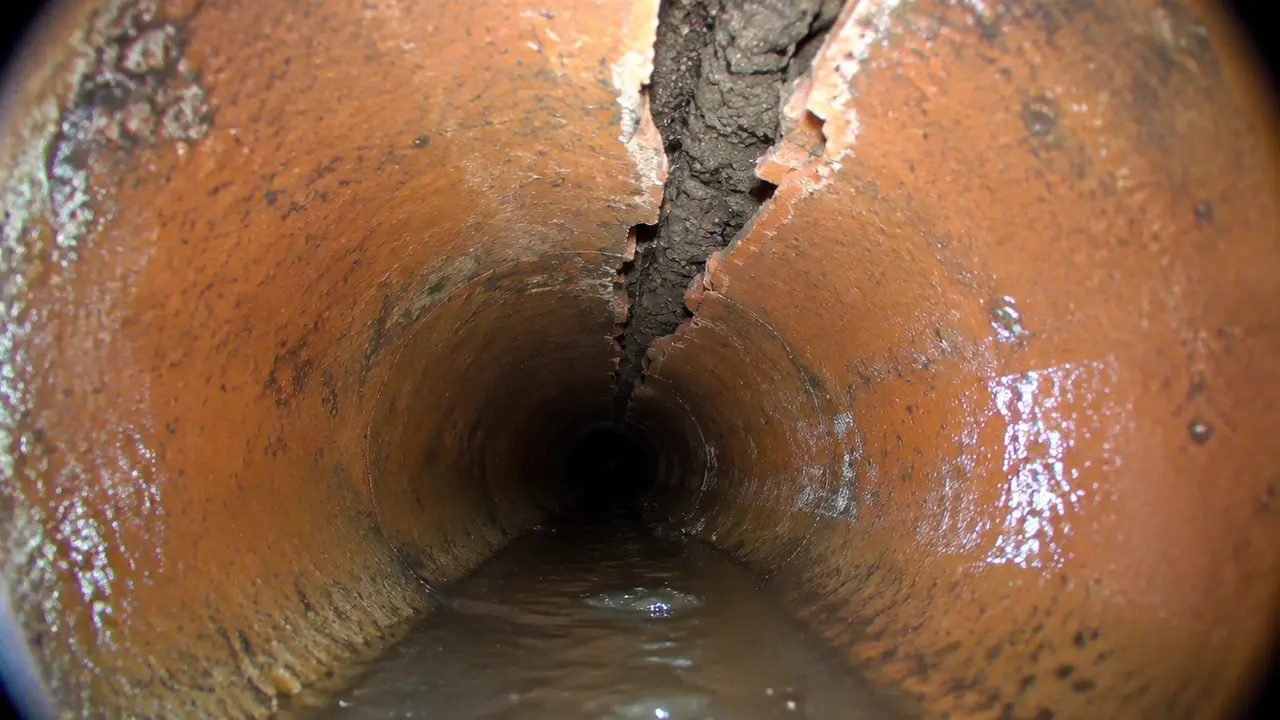
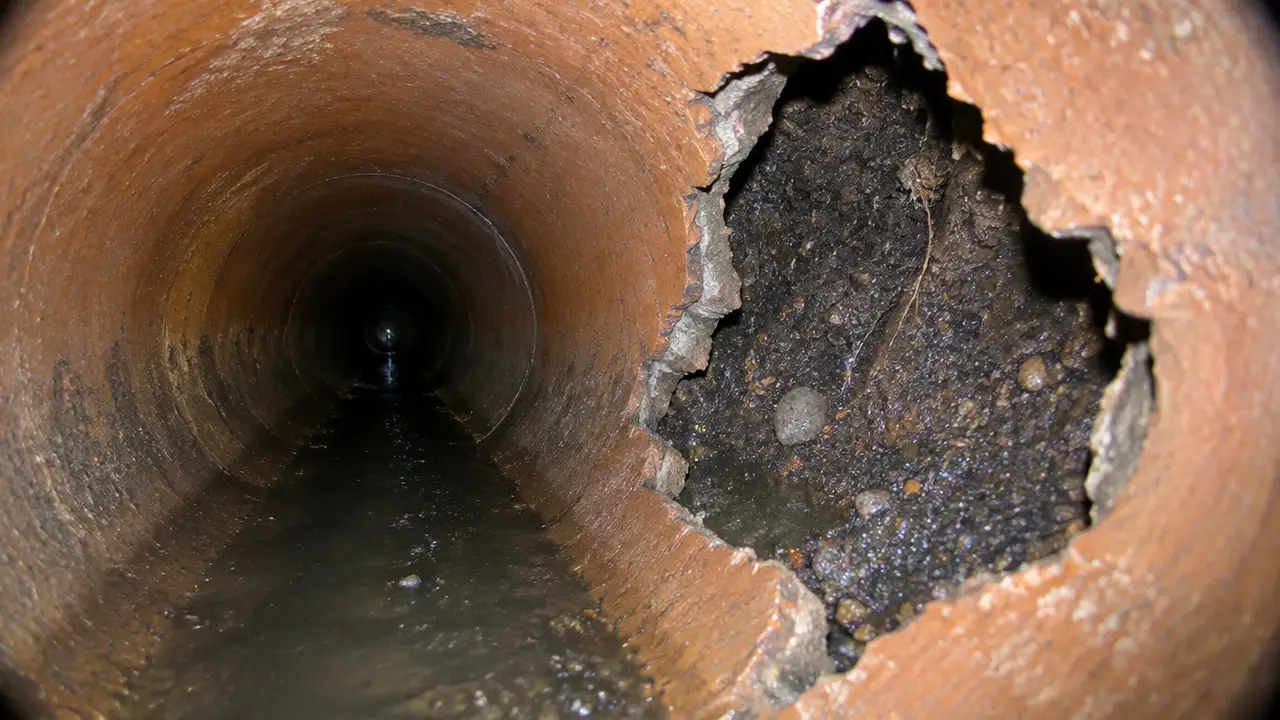
Not every problem line needs replacing. Replacement is the right call when the camera shows the pipe itself is failing, not just one joint. When a recorded scope shows several failure points, a belly holding water, offset joints, roots entering at more than one location, or a pipe material that has aged out, replacement is usually the honest recommendation. Spot repairs on a line failing in several places spend money without fixing the underlying problem.
| Finding | Usually points to | Why |
|---|---|---|
| One crack or root intrusion, sound pipe either side | Repair | The rest of the pipe still has life |
| Defects repeating along the run | Replacement | Fixing one leaves the next |
| Sag or belly holding water | Replace at least that section | A liner follows the old grade |
| Collapse, break or hole | Dig or burst at that spot, often replace | A liner cannot form across a gap |
| Bituminous fibre (Orangeburg) | Replacement | It deforms and delaminates |
| Old cast iron with heavy scale throughout | Often replacement | The bottom wall can be thin |
The New Line or Repair? Check turns these patterns into a score you can read line by line, and new line vs repair explains the reasoning behind each rule. If you already have footage and a replacement quote, those two pages are the fastest way to structure a second opinion.
03 /Which Calgary neighbourhoods see the most lateral replacements?
Older communities built before about 1960, such as Killarney, Bowness, Bridgeland, Inglewood, Renfrew, Rosedale, Mount Pleasant and Sunnyside, are now on their second or third generation of owners, and many private laterals there date from the original build. Replacement returns those lines to a documented, code-compliant state with a long service life ahead.
The City's own records support that picture on the City side of the property line. In its public sanitary service line data, as mapped in the network's Calgary atlas, about half of the City-side service lines in Inglewood, Renfrew, Rosedale, Ramsay and Bankview are dated before 1960, and a large share of Bowness's City-side lines are recorded as cast iron. Those records describe only the City's section; the City notes that the private side can be a different material and age. Treat them as a clue about your street, not a report on your pipe. The Calgary service area page has the numbers community by community.
04 /What does a complete lateral replacement include?
A complete replacement is more than digging and laying pipe. When you compare quotes, check that each one covers the whole list below, or says clearly which items are yours.
- An on-site scope with a recorded camera inspection of the existing line and a locate of its route and depth.
- Utility locates through Utility Safety Partners, Alberta's one-call service, before any digging, plus a private locate for customer-owned lines, which the one-call does not mark.
- Permits: in Calgary a plumbing permit, since the City lists replacing water and sewer lines as permitted work, plus an excavation permit for any digging in a City road right-of-way.
- A protected trench: cut back, benched or shored as Alberta's OHS Code requires once it is deeper than 1.5 m, with spoil managed and driveways and lawns protected.
- The new pipe on proper bedding, graded to the slope the code and the design require, connected at both ends.
- An inspection of the open trench before backfill goes in.
- Compacted backfill in lifts, grade restoration and a written restoration plan.
- Records: before and after video, the inspection record and an as-built sketch showing depth, cleanout locations and the connection point.
A new cleanout near the foundation is worth adding while the trench is open: it gives every future camera and cable a clean way in. What each surface restoration line should say is covered in excavation and restoration, and the full order of work is in the ten-step process.
05 /What should I refuse from a contractor?
Two things are worth refusing outright. The first is a fixed price for a lateral replacement given sight unseen. A contractor who quotes a firm number online without a camera scope is guessing, and when the job meets conditions nobody budgeted for, it is your line and your wallet that absorb the guess. Every honest replacement quote starts with footage.
The second is old pipe left in the ground without a record. Where site conditions allow, failed pipe should come out. Where a section has to be abandoned, for example under a structure that cannot be disturbed, it should be noted in writing, capped as the code requires and marked on the as-built, so the next owner and the next contractor know it is there.
- No written scope of method, length and pipe material.
- No mention of permits, or "permit by owner" when a contractor is doing the work.
- "Rough grade only" as the entire restoration line.
- No inspection before backfill.
- No after-video of the new line.
- A large deposit before any permit is issued.
06 /How long does a sewer lateral replacement take?
Most single-family replacements run one to three working days from breaking ground to backfill, provided the locate is clean and permits are in hand. Deep lines, long runs, driveway removal and winter frost work extend that. A written quote should include a schedule commitment, with the conditions that could change it.
The weeks before the dig matter more to your calendar. The scope and quotes, the locate request (Utility Safety Partners asks for at least three full working days of notice for a routine request) and the permit application usually take longer than the dig. During the work itself, plan for a period with no drains, from part of a day to longer on open-cut jobs, and ask for that window in writing. The project planner lays out the steps with the Calgary and Alberta rules that apply to each.
07 /Does the City of Calgary replace or reline laterals?
The City runs a sanitary lateral lining program that installs liners inside existing sanitary service pipes to extend their life, without excavation. Its program page tells residents to pour about four litres of water into each floor drain, tub and shower beforehand, to avoid using water during the work, and that the connection will be out of service for about three hours. It does not describe replacing a homeowner's private section.
If a City crew is lining in your area, that is a good moment to ask 311 how it affects your connection and whether your own side should be scoped at the same time. A sound City section joined to a failing private one still backs up into your basement. What a full replacement costs is set out in the cost guide, and when you want contractors to price it, send your footage and details.
FAQQuestions people ask
What is the difference between sewer lateral replacement and sewer line repair?
A repair fixes one location, usually by a small dig or a sectional liner. A replacement renews the whole private lateral from the house stub to the municipal connection.
How long does a sewer lateral replacement take in Calgary?
Usually one to three working days on site for a single-family home once permits and locates are in place, longer for deep lines, long runs, concrete removal or winter work.
Do I have to replace the City's part of the lateral too?
In Calgary the City owns and maintains the section from the main to the property line. If the camera shows a problem there, call 311; City-side work is arranged separately from your private replacement.
Should a new cleanout be part of a lateral replacement?
It is strongly worth it. A cleanout installed while the trench is open costs far less than adding one later and gives every future inspection and cleaning a clean access point.
Can a contractor leave the old pipe in the ground?
Sometimes a section has to be abandoned, for example under a structure. It should then be capped as required, noted in writing and marked on the as-built drawing.
NETWORKGo deeper across the HAUSE Sewer network
Sewer line replacement cost: open-cut vs trenchless, line by line
Sewer line replacement cost in Canada for 2026: open-cut, CIPP lining and pipe bursting planning ranges in CAD, per-metre math, line items and what moves price.
What pipe do I have? Identify your drain pipe material
What pipe do I have? Identify a drain pipe from its look, joints, markings and house age, with a confidence rating, safe cleaning methods and camera advice.
Sewer pipe materials by construction era, and what each looks like on camera
Sewer pipe materials by era in Canadian homes: clay, cast iron, Orangeburg, concrete, ABS and PVC, how each one fails and what it looks like on camera.