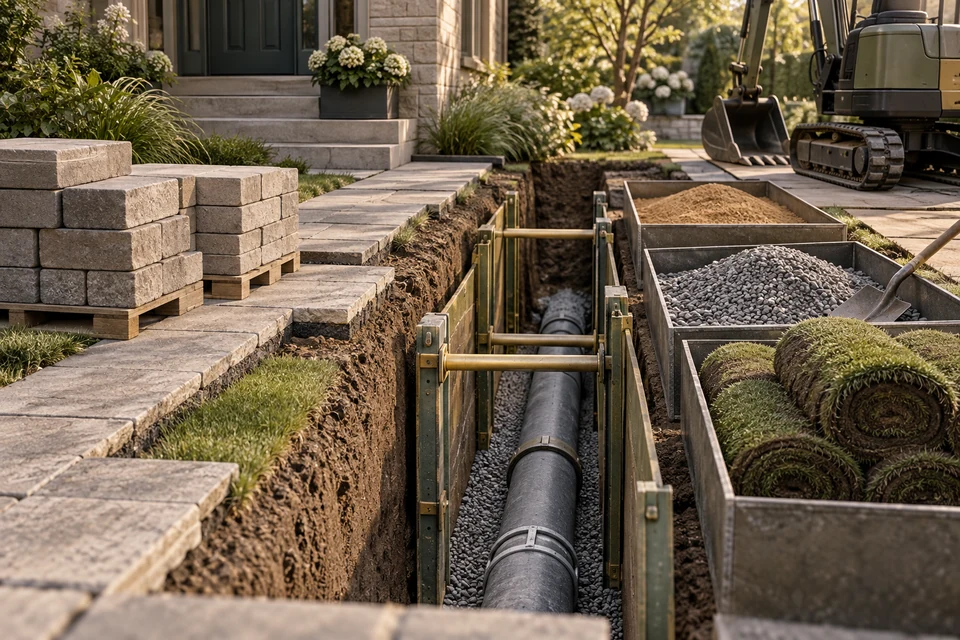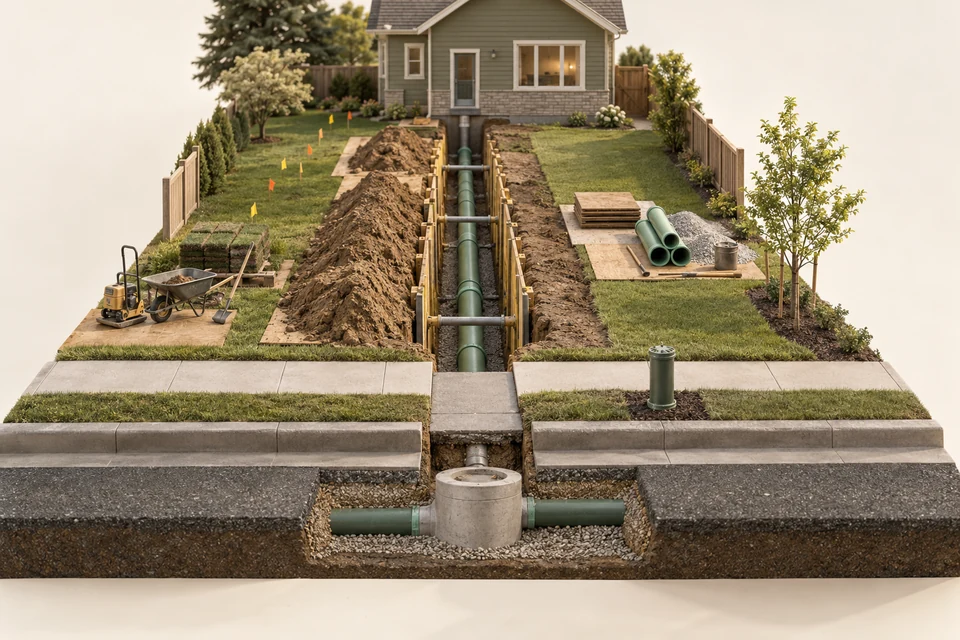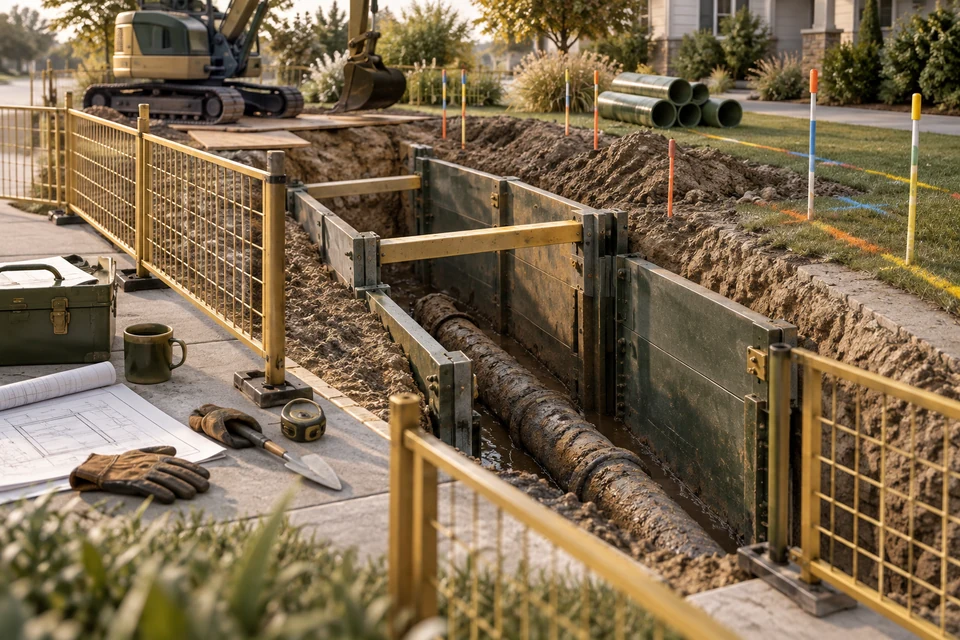
In Calgary, a homeowner can take out a plumbing permit only for a home they own and live in, and only for work they do themselves; the permit brings inspections. In practice, a sewer line replacement also means utility locates, a trench that becomes dangerous past about 1.5 m, heavy equipment and a tie-in at the property line, so most homeowners hire the pipe work and save money on preparation and restoration instead.
- Calgary homeowner plumbing permits are for owner-occupants doing their own work, and they come with rough-in and final inspections.
- Plumber is a compulsory certification trade in Alberta, and a homeowner cannot pull a permit on a contractor's behalf.
- New connections from the Calgary property line are installed by contractors on the City's approved indemnified list.
- Trench collapse is the main danger: walls can fail without warning, and depth is not the only factor.
- Clearing landscaping, simple restoration and gathering footage and quotes are where do-it-yourself effort actually saves money.
01 /Is it legal for a homeowner to replace their own sewer line?
In Calgary, the City's trades permit page allows a homeowner permit for plumbing work, including replacing water and sewer lines in or around the home, on three conditions: you own the home, you live in it (it is not a rental), and you do the work yourself. It also says a homeowner cannot pull a permit on behalf of the person or company doing the work. So a homeowner permit is a route for genuine do-it-yourself work, not a way to hire unpermitted help.
Other rules narrow the field further. Plumber is a compulsory certification trade in Alberta, which governs people working in the trade. For new service connections, the City says connections from the property line to the building are installed by contractors on its approved indemnified list. Any digging into a City road right-of-way needs an excavation permit issued to those doing the work. Outside Calgary, homeowner permit rules are set by your municipality or its accredited agency, so ask them directly.
| Task | Homeowner (own home, lives there, does the work) | Needs a contractor |
|---|---|---|
| Replace the private building sewer | Possible with a homeowner plumbing permit | If anyone else does the work |
| New service connection from the property line | Not described as a homeowner option | Contractor on the City's approved indemnified list |
| Dig in the road right-of-way | No | Excavation permit holder |
| Inspections | Book rough-in and final | Contractor books them on its permit |
02 /What does a homeowner permit involve in Calgary?
The City listed the homeowner plumbing permit fee as $112 plus a 4 percent Safety Codes Council fee, $116.50 in total, in September 2026. Two inspections come with it: a rough-in inspection once all drainage and venting are installed, and a final inspection once fixtures and equipment are ready for use. Inspections are booked through the City's residential inspections system after each stage is complete.
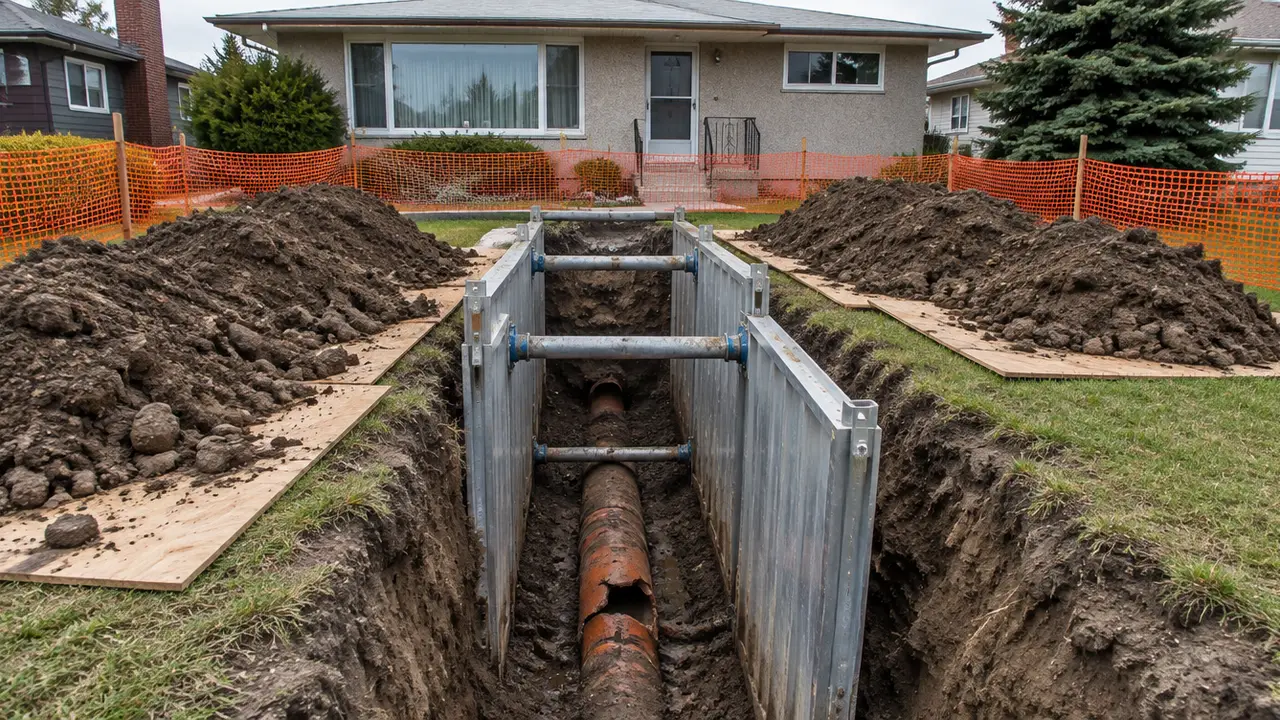
For a sewer line, the rough-in inspection is the one that matters: the pipe, its bedding, grade and connections have to be seen in the open trench. That means the trench has to stay open, safely, until the inspector has been, which is one of the practical reasons homeowner sewer replacements are rare.
03 /Why is digging a sewer trench so dangerous?
Because trench walls fail suddenly and soil is heavy. A partial collapse can pin a person before they can move. Alberta's OHS Code sets the rules for work sites: protection by cut-back walls, a temporary protective structure or both once a worker is in an excavation deeper than 1.5 m and closer to the wall than its depth; spoil at least 1 m back from the edge; a safe exit within 8 m; and engineer-designed protection past 3 m. Those rules exist because unprotected trenches kill and injure workers.
- Collapse: walls can fail at any depth in loose or wet soil, and the risk rises sharply as the trench deepens.
- Buried services: gas, power and telecom lines, some of them shallow and near the house.
- Sewer gas: an open sewer can release hydrogen sulphide and leave low-oxygen air in the bottom of a trench.
- Machinery: a rented mini excavator on a small lot, near a foundation, next to an open trench.
- The foundation: digging beside footings can undermine them.
04 /Do I still need locates if I do the work myself?
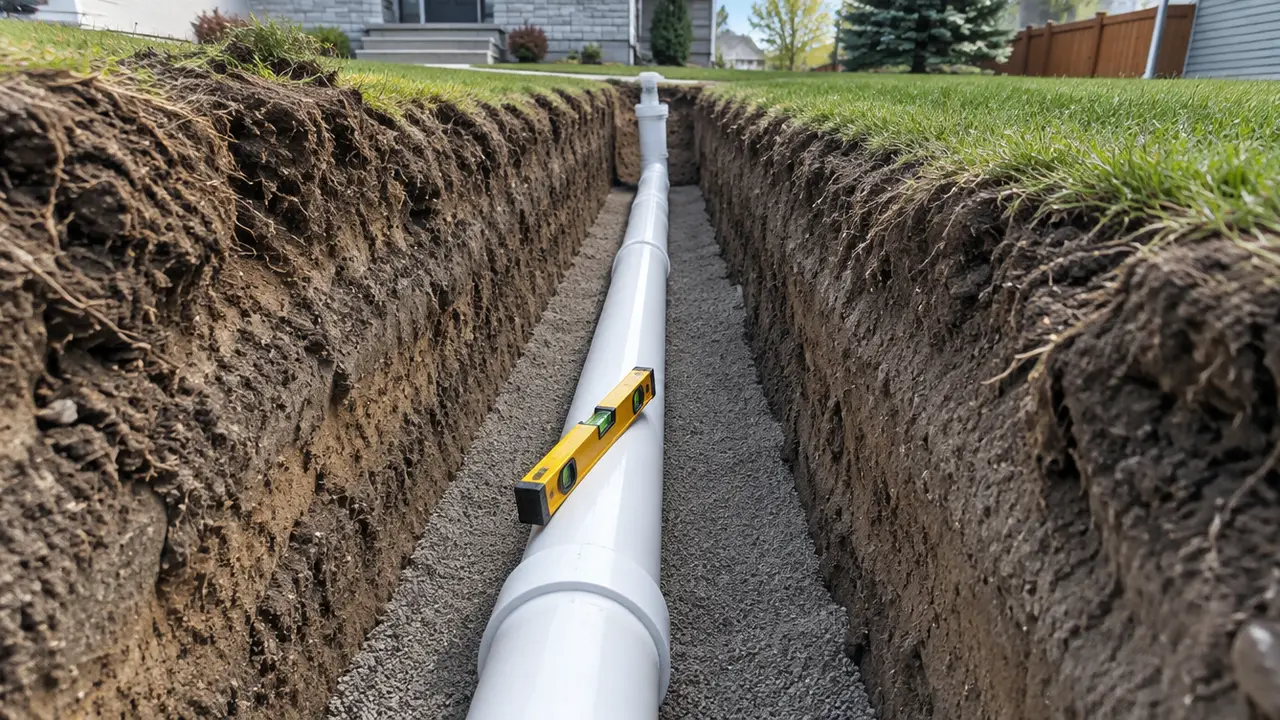
Yes. Utility Safety Partners serves homeowners as well as contractors and asks for requests at least three full working days before digging. Its homeowner guidance says that within one metre on either side of the markings, or five metres from high-pressure pipelines, lines should be exposed carefully with hand tools to find their exact location and depth.
The one-call does not mark customer-owned lines, and the sewer you are replacing is one of them. Utility Safety Partners says those lines are not registered with it and suggests hiring a private locator. A camera with a sonde can trace the sewer itself.
Locates also expire. Utility Safety Partners says the locate documentation shows when it expires, and that work continuing past that date needs a relocate ticket. Do-it-yourself projects often stretch over weekends, so check the date on your locate before each day of digging, and ask for a relocate if marks have been scuffed away by the work.
05 /Which parts can a homeowner sensibly do?
The parts that save real money without the dangerous or regulated work are before and after the dig. Many contractors are happy to price a job with owner scope written in, as long as it is clear in the quote.
- Get the footage: hire a camera inspection and locate first, and keep the recording.
- Gather comparable quotes: give every contractor the same scope; the project planner helps you write it.
- Clear the route: move planters, remove a fence panel, lift pavers or dig out plants you want to keep before the crew arrives.
- Simple restoration: topsoil, seed or sod over the trench once it has settled, and replanting.
- Inside the house: move contents, protect floors and keep drains out of use during the no-drain window.
- Records: file the permit, inspection record, as-built and after-video with the house papers.
Write any owner scope into the contract as a line item, so both sides know which surfaces the crew restores and which you do. How restoration lines should read is covered in excavation and restoration.
06 /Is doing it yourself actually cheaper?
Less than it looks. Equipment rental, disposal of old pipe and spoil, bedding and fill, pipe and fittings, a private locate and the permit all cost money whoever digs. The saving is mostly labour, and against it sit the time, the risk, the need to keep a trench open and safe until inspection, and no workmanship warranty. A mistake in grade or bedding can mean digging the line up again.
As a 2026 planning estimate, a professionally installed new lateral typically quotes about $12,000 to $35,000 CAD by open cut for a 15 to 25 m run, and less when the route is short, shallow and under lawn. If the quotes feel too high, the better levers are a second opinion from the same footage, asking whether a repair would do, and doing the preparation and restoration yourself. The New Line or Repair? Check is a good place to start, the cost page shows the line items, and when you want quotes, send your footage.
FAQQuestions people ask
Is a homeowner allowed to lay their own new sewer line in Calgary?
Only under a homeowner plumbing permit, which the City allows for a home you own and live in when you do the work yourself. The permit brings rough-in and final inspections.
Can I hire a friend to help under my homeowner permit?
The City says a homeowner cannot pull a permit on behalf of the person or company doing the work. If someone else is doing the work, they need the permit.
Do I need to call before I dig for a sewer line?
Yes. Request locates through Utility Safety Partners at least three full working days ahead, and hire a private locator for your own lines, which the one-call does not mark.
How deep can I dig a trench safely?
There is no safe depth in loose or wet soil. Alberta requires protection on work sites past 1.5 m for a worker near the wall. Do not enter an unprotected trench.
What parts of a sewer replacement can I do myself to save money?
Getting footage and quotes, clearing the route, moving contents, and simple restoration such as topsoil, seed or sod. Put any owner scope in the contract.
NETWORKGo deeper across the HAUSE Sewer network
Sewer root removal cost in Canada: cutting, chemicals and permanent fixes
Sewer root removal cost in Canada for 2026: planning ranges for cable cutting, jetting, camera, lining, bursting and replacement, plus cycle-versus-fix math.
Sewer permits, inspections and who pays: owner or city?
Sewer line permits and who pays in Canada: the usual owner vs city split, permit and inspection costs, road cuts, city tree roots and what to confirm.
Sewer camera inspection certification and training: what it proves
Sewer camera inspection certification and training in Canada: NASSCO PACP and LACP, home inspector courses, safety training and what a credential proves.