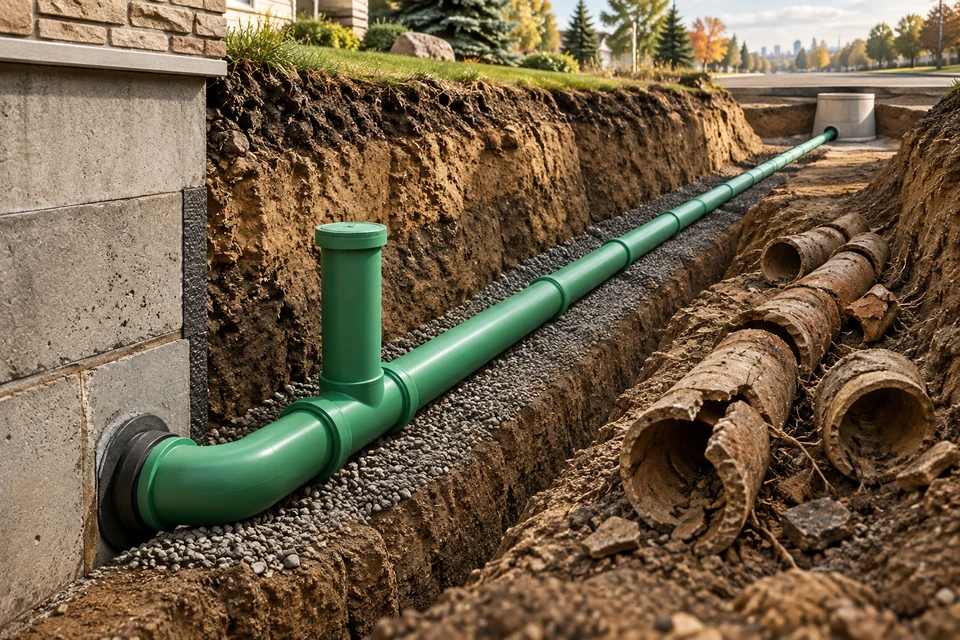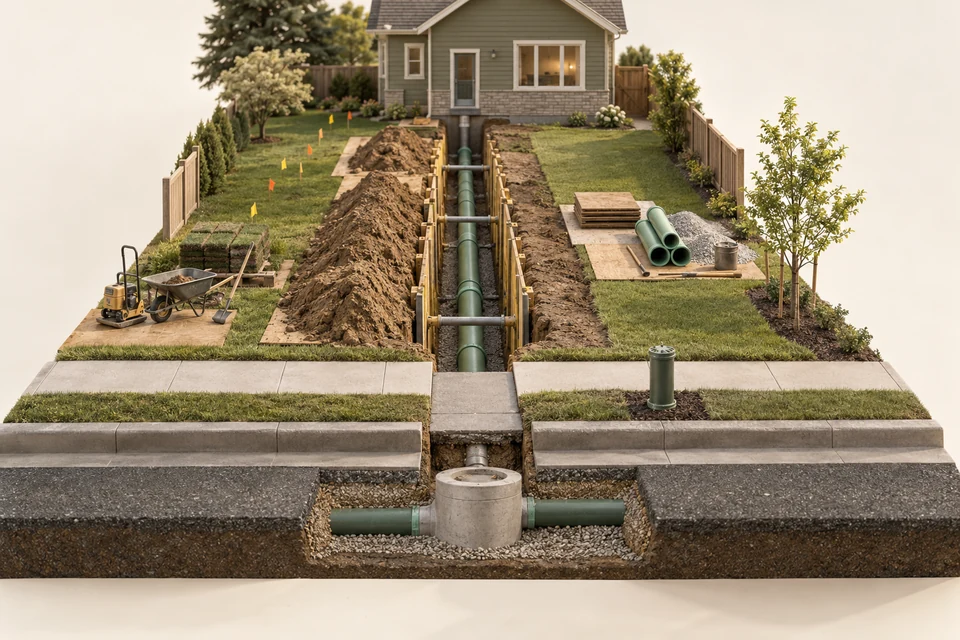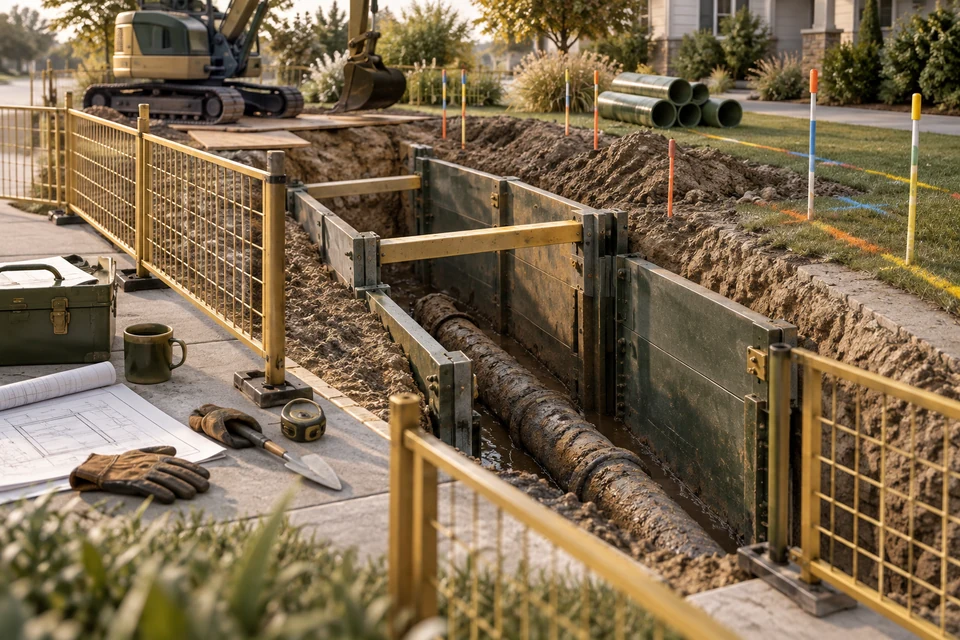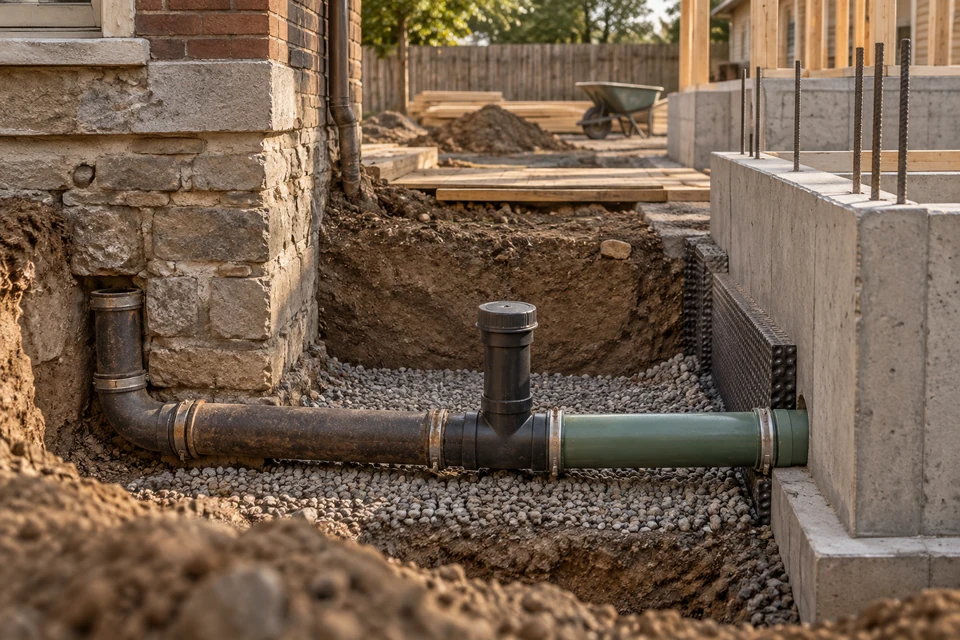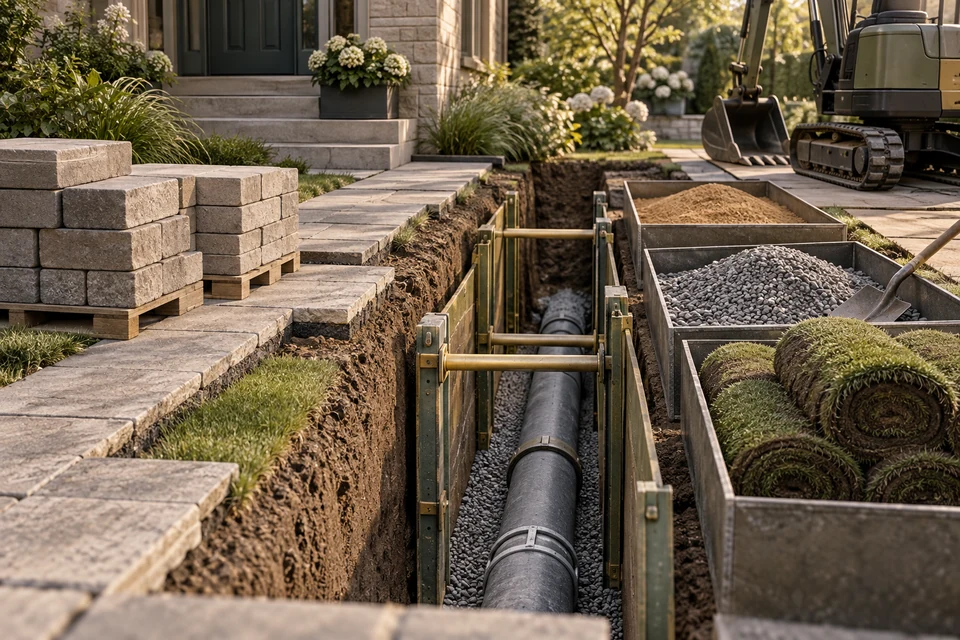
Sewer line excavation starts with utility locates and a route plan, uses a trench protected as Alberta's OHS Code requires once it is deeper than 1.5 m, and stays open only long enough to lay the pipe and pass inspection. Restoration should be planned with the dig: bedding and compacted backfill in lifts, then every surface the trench crossed listed as included, optional or owner scope.
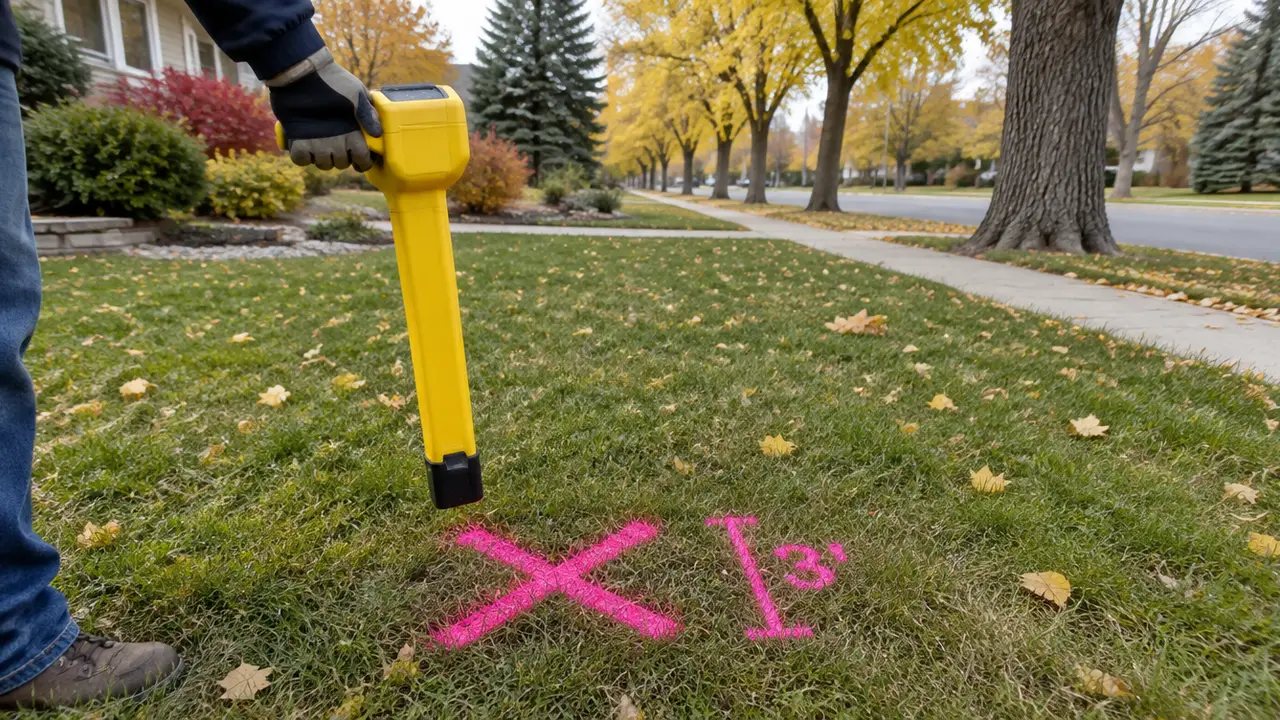
- Locate marks show registered utilities only; your sewer, water service, sprinkler and garage power lines need a private locate.
- Within one metre either side of a locate mark, lines are exposed with hand tools before machines dig.
- Past 1.5 m deep, workers near the wall must be protected by cut-back walls, a protective structure or both, and spoil stays at least 1 m back.
- Backfill in compacted lifts decides whether a driveway settles over the trench later.
- Every restoration surface should be its own line item, never a lump sum.
01 /What has to happen before anyone digs?
Excavation for a sewer lateral touches everything above it: sod, driveway, sidewalk, garden beds, mature trees and irrigation. The trench, its protection, the utility clearances and the restoration should be planned as one continuous scope, so nothing surprises you when the pipe is in and the trench is being closed.
- Utility locates through Utility Safety Partners for gas, power, telecom and other registered utilities. The service asks for at least three full working days of notice for a routine request.
- A private locate for customer-owned lines, which the one-call does not mark: your sewer and water service lines, sprinkler systems and lines between buildings.
- A route plan that checks depths of surrounding utilities and avoids conflicts.
- A trench-protection plan chosen for depth and soil: sloped walls, benching, shoring or a trench box.
- Traffic and pedestrian control where the trench meets a sidewalk or road, and a City excavation permit for any digging in the road right-of-way.
- Surface protection for driveways, mature landscaping and irrigation heads that are staying.
02 /How close can a machine dig to a marked line?
Not very. Utility Safety Partners' homeowner guidance says that when digging within one metre either side of the markings, or five metres from high-pressure pipelines, the line should be carefully exposed with hand tools to find its exact location and depth. Alberta's OHS Code carries the same idea for work sites: mechanical excavation is not permitted within a buried facility's hand-expose zone until the facility has been exposed by hand digging or a non-destructive method acceptable to its owner.
In practice that means an experienced operator with a spotter, hand digging or vacuum excavation around crossings, and time built into the schedule for it. The gas service to the house often crosses the sewer route near the foundation, which is exactly where the trench is deepest. If a quote assumes a machine can run straight through, ask how crossings will be exposed.
03 /How must a deep sewer trench be protected in Alberta?
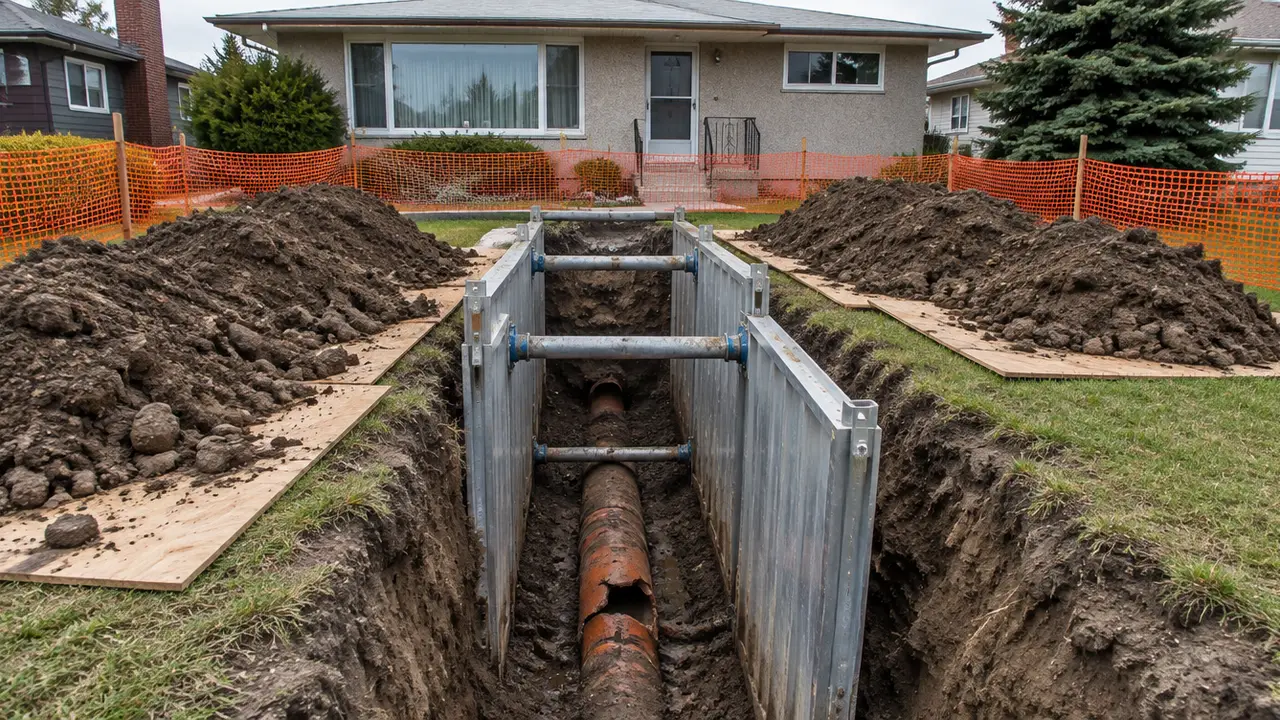
Alberta's Occupational Health and Safety Code, Part 32, sets the rules. Before a worker begins working in an excavation more than 1.5 m deep and closer to the wall than the excavation's depth, the employer must protect them from cave-ins and sliding or rolling material by cutting back the walls, installing temporary protective structures, or both (section 450). The exception is a trench in solid rock throughout.
| Rule | What it says | Section |
|---|---|---|
| When protection starts | More than 1.5 m deep and a worker closer to the wall than the depth | 450 |
| Hard and compact soil | Walls sloped to within 1.5 m of the bottom at not less than 30° from vertical | 451 |
| Soil likely to crack or crumble | Sloped to within 1.5 m of the bottom at not less than 45° from vertical | 451 |
| Soft, sandy or loose soil | Sloped from the bottom at not less than 45° from vertical | 451 |
| Spoil piles | Leading edge at least 1 m from the edge; face no steeper than 45° | 453 |
| Getting in and out | A safe exit within 8 m of the worker in trenches over 1.5 m | 455 |
| Protective structures | Engineer-designed and installed when more than 3 m deep | 456 |
Sloping takes space, and a 45-degree cut on a deep trench can be wider than the side yard. That is why urban laterals are often dug with a trench box or shoring, and why the protection method belongs in the quote. A price that treats a 3 m trench like a 1.2 m one is either wrong or skipping protection.
04 /How long does the trench stay open?
Only as long as the pipe installation and the inspection take. Spoil should be placed so the trench edge stays clear and, where practical, the driveway or lawn stays usable. A trench left open overnight should be barricaded or plated so nobody, including children and pets, can fall in. The inspection happens with the trench open, before any backfill, so the inspector can see the pipe, its bedding and both connections.
Weather changes this. Rain can soften trench walls and flood the bottom, which may mean pumping and re-checking the walls before anyone goes back in. In winter, frost may have to be broken or thawed at the start, and open trench walls can freeze and thaw overnight. Ask how the crew plans for both.
05 /Why does backfill decide whether the driveway sinks?
Because a trench refilled in one go settles for years. Good backfill has three layers: bedding material under and around the pipe to support it, compacted lifts that bring the trench back up in layers a compactor can actually consolidate, and suitable fill to finish grade. Shortcutting it saves half a day and costs a sunken driveway or a dip in the lawn later.
The City of Calgary treats this seriously on its own land. Its excavation permit page says contractors working in the road right-of-way are responsible for maintaining the trench backfill for a two-year period, and each permitted site is inspected. On private property, ask for the backfill method and compaction approach in writing, and for any warranty on settlement to say how long it lasts and what it covers.
06 /What should a restoration plan list?
Every quote should list exactly which surfaces are coming out and what is included in putting them back. Concrete driveways and walks, sidewalks, asphalt, sod, landscaping and irrigation should each appear as a line item that is included, priced as an option, or noted as owner scope, so you can compare quotes. Nothing should hide inside a lump sum called restoration.
| Surface | Planning adder | Ask about |
|---|---|---|
| Lawn: topsoil and seed | Usually part of backfill | Sod instead of seed, watering, when it is considered finished |
| Landscaping, trees or a fence | $500–$2,000 | Tree root protection, replacement plants, fence panels |
| Concrete driveway or walk | $1,500–$5,000 | Full panels or patches, finish, cure time before use |
| Finished basement floor | $2,000–$6,000 | Slab, vapour barrier, flooring and wall finishes |
| Sidewalk, boulevard, road | Set by the municipality | Who restores it and to what standard |
Winter jobs often get temporary restoration, such as rough grade or cold patch, with the final surface in spring. If so, the quote should say when the return visit happens and what it includes. To see how surfaces change your planning range, try the project planner, compare with the cost guide, and see where excavation sits in the ten-step process. When you are ready, request quotes with a restoration list attached.
FAQQuestions people ask
Does the utility locate mark my sewer line?
No. Utility Safety Partners says customer-owned lines, such as water and sewer service lines, sprinkler systems and lines between buildings, are not registered with it. A private locator or a camera with a sonde marks them.
How deep can a sewer trench be before it needs shoring?
In Alberta, protection is required once a worker is in an excavation deeper than 1.5 m and closer to the wall than its depth: cut-back walls, a protective structure such as a trench box, or both.
Will my driveway be replaced after a sewer line dig?
Only if the quote says so. Concrete removal and replacement should be a separate line item stating whole panels or patches, the finish and how long before you can drive on it.
Why does the trench need to stay open for an inspection?
So the inspector can see the pipe, the bedding and both connections before they are buried. Backfilling first means nobody can confirm what is underground.
Who restores the sidewalk and boulevard after a sewer dig in Calgary?
Work in the City road right-of-way needs an excavation permit and follows City standards, and the permit holder maintains the trench backfill for two years. Ask your contractor who is doing that restoration.
NETWORKGo deeper across the HAUSE Sewer network
Sewer line replacement cost: open-cut vs trenchless, line by line
Sewer line replacement cost in Canada for 2026: open-cut, CIPP lining and pipe bursting planning ranges in CAD, per-metre math, line items and what moves price.
How to clean the pipes under a kitchen or bathroom sink
How to clean the pipes under a sink: remove and scrub the P-trap, clear the trap arm, fix a slow bathroom stopper, and reassemble without leaks, step by step.
Drain auger safety: how rotating cable injures, and how to stop it
Drain auger safety: how rotating cable injures hands and arms, the right gloves, foot pedal control, electrical and sewer gas hazards, and hard stop rules.